



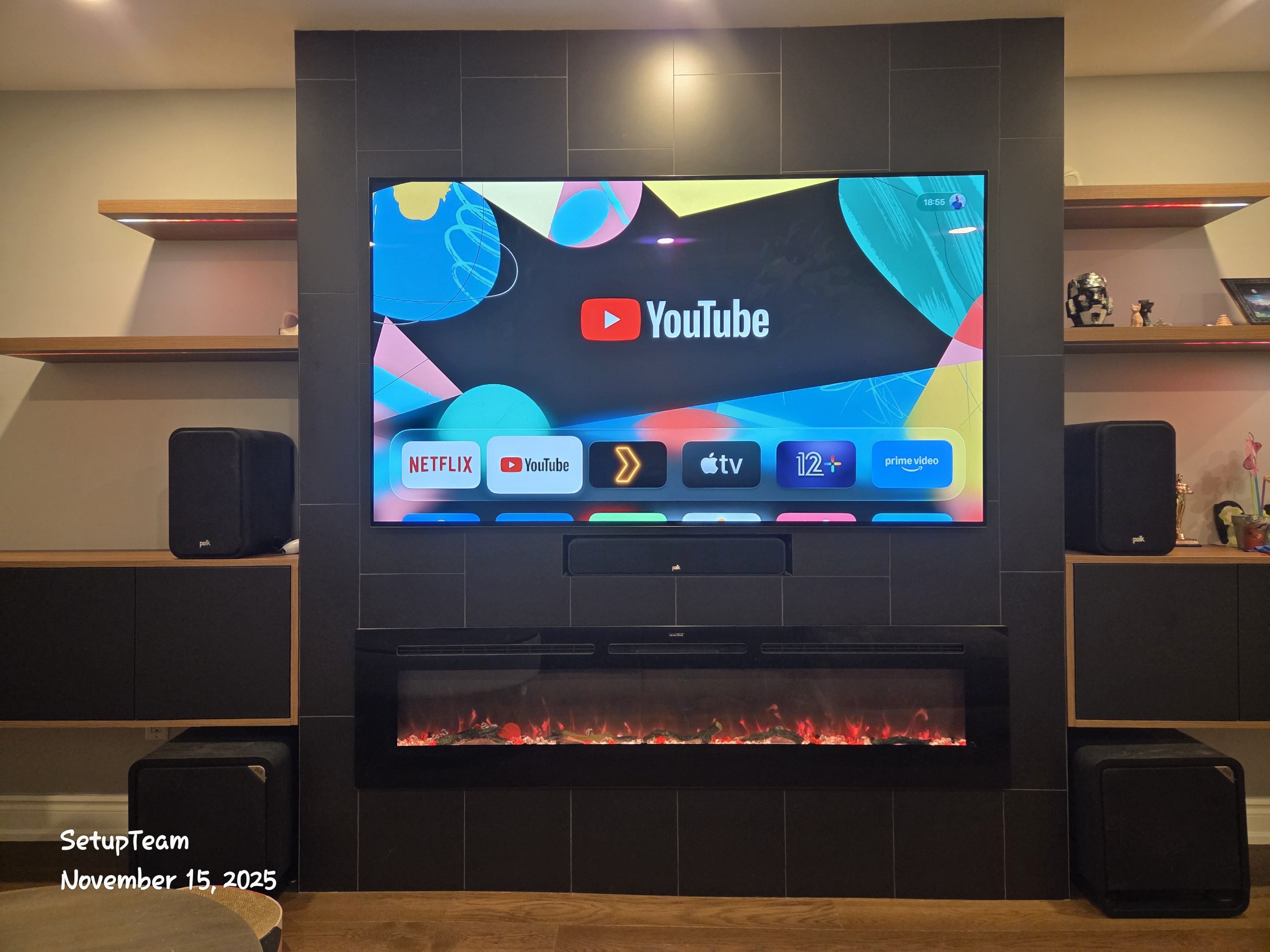
TV Speakers vs Soundbars vs Home Theater Systems
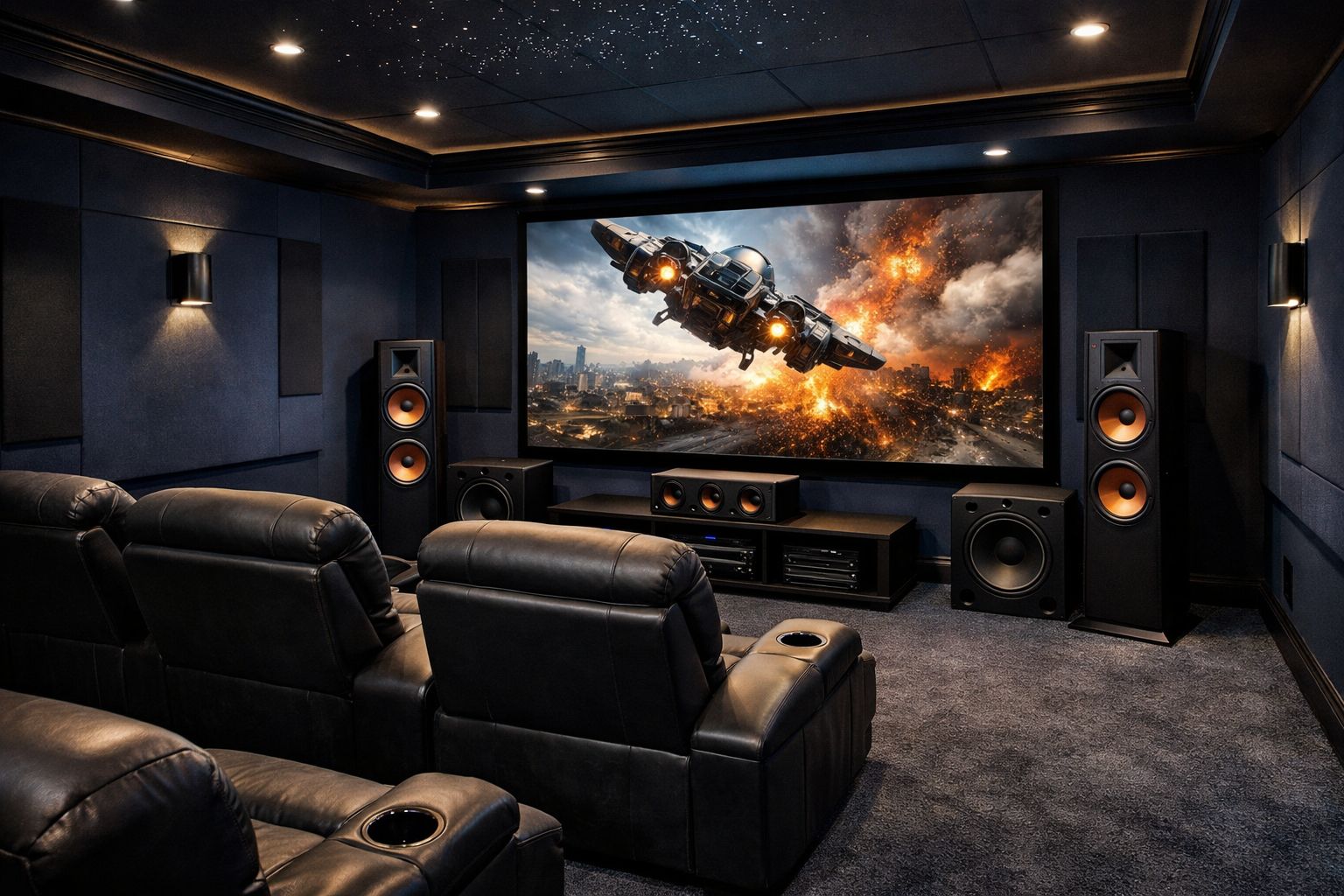
TV Speakers vs. Soundbars vs. a Real Home Theater System: What’s Actually the Difference?
A premium OLED deserves audio that matches the picture. Here’s what changes — technically and experientially — as you move from built-in speakers to a soundbar to real surround sound.
You just bought a new 65-inch or 77-inch OLED. The picture is stunning — deep blacks, extraordinary contrast, detail sharp enough to make broadcast footage look cinematic. Then you press play on a movie, and something feels immediately off. Dialogue is harder to follow than expected. Bass is thin. The whole experience feels oddly flat for a screen that cost this much.
This is one of the most common frustrations we hear from homeowners after TV wall mounting. The television looks exactly right on the wall. The audio tells a different story entirely.
Sound matters as much as the image — arguably more during long viewing sessions. Once you understand what separates built-in TV speakers from a soundbar from a proper surround system, the gap in listening experience stops being surprising. This guide breaks down the technical reasons behind each tier, what you’ll actually notice in daily use, and how to decide which upgrade is worth the investment.
Why Almost Any External System Outperforms Built-In TV Speakers
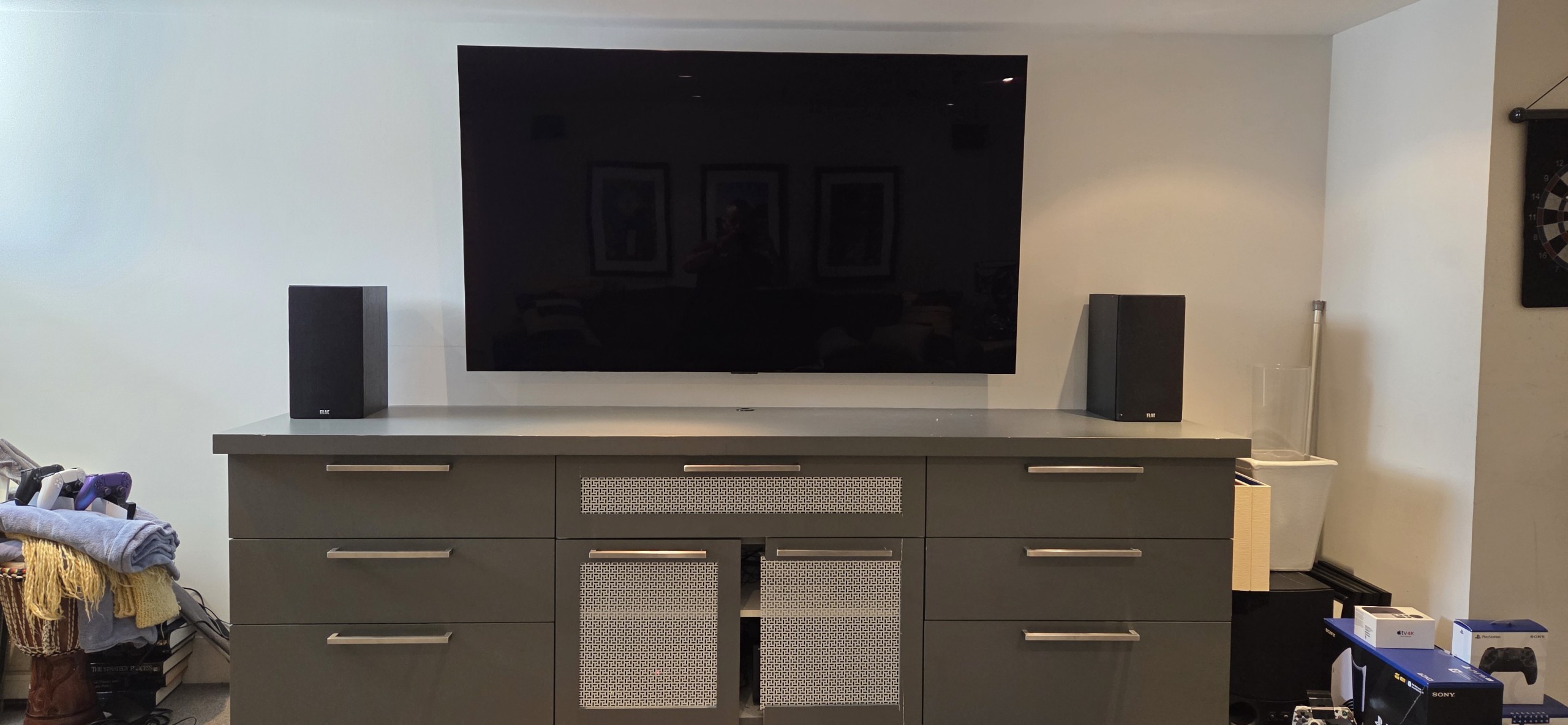
Before comparing options, one point deserves to be stated plainly: almost any dedicated audio system will outperform the speakers inside your television. Not marginally — dramatically.
Modern televisions are engineered around thinness. Panels under 25mm deep leave almost no internal volume for speaker drivers. Manufacturers are forced to use very small drivers — often between 10W and 20W total — housed inside a chassis that simply cannot move enough air to fill a room. The result is predictable: weak bass below 100Hz, compressed dynamics, and sound that frequently bounces off the wall behind the TV rather than projecting toward the listener.
Two complaints come up constantly:
- Dialogue that requires constant volume adjustments to follow clearly
- Action sequences and music that feel hollow, weightless, or flat
Even a mid-range soundbar solves most of this immediately. Larger, forward-facing drivers direct sound toward the seating area rather than away from it. Dialogue becomes clearer without raising volume. The full frequency range — from speech intelligibility through mid-bass impact — becomes more balanced and more present.
For most homeowners, adding a soundbar alongside a wall-mounted TV transforms what would have been a visual upgrade into a genuinely complete one.
The Physics Problem Inside Every Slim Television
The elegance of a wall-mounted OLED comes at a cost that rarely appears in the marketing materials.
Thin panels leave almost no interior volume for speaker enclosures. Small drivers in tight enclosures cannot produce meaningful bass, and their orientation — typically downward-firing or rear-facing — means sound reflects off surfaces before it ever reaches the room. The frequency response rolls off sharply below 120–150Hz, which is exactly where male dialogue, cello, and film score low-end lives. Physics, not build quality, is the constraint.
The most common complaint homeowners have when they start exploring home theater options comes down to one sentence:
“We can’t understand what anyone is saying.”
Turning up the volume doesn’t fix this. It amplifies the same compromised frequency response — just louder. The clarity problem remains because the issue is bandwidth, not amplitude. A dedicated center channel or a quality soundbar with a speech-optimized driver addresses this at the source.
What a Soundbar Actually Changes
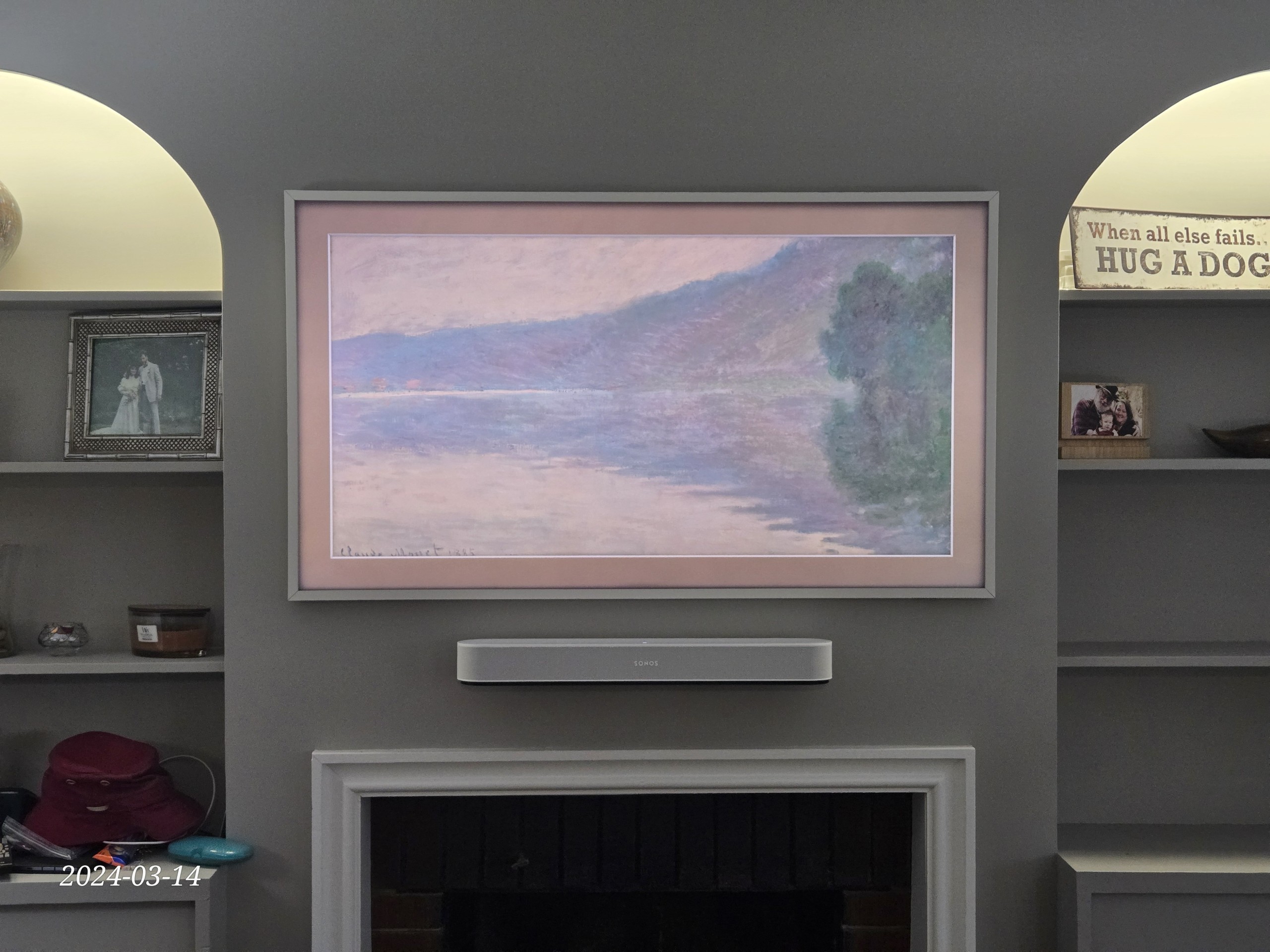
A quality soundbar addresses the core limitations of TV audio in a straightforward way: it replaces small, compromised drivers with larger, forward-facing ones specifically tuned for dialogue intelligibility, mid-range presence, and wider stereo separation.
Even an entry-level Sonos Beam produces noticeably cleaner speech reproduction and fuller mid-range than virtually any built-in television speaker. For homeowners in condos or tighter living rooms, this alone represents a meaningful shift in daily listening comfort.
One benefit that tends to surprise people: a good soundbar lets you listen at lower volumes while still following conversation clearly. That matters more than most expect, particularly late at night or in shared living situations where volume is a constraint.
Add a subwoofer — like the Sonos Sub or a comparable wireless unit — and the improvement compounds. Bass becomes physical rather than suggested. Film scores breathe. Action sequences stop sounding like they were mixed for a laptop. Most quality soundbar-and-sub combinations cover the 35Hz–20kHz range, which is a dramatic improvement over the 150Hz–15kHz that built-in TV speakers typically manage.
That said, a soundbar has one structural limitation it cannot overcome: all sound originates from the same point in the room — directly in front of you. No amount of DSP processing changes the physical fact that a single enclosure cannot place discrete sounds behind or beside the listener.
Soundbar vs. 5.1 Surround: The Difference You Actually Hear
Premium soundbars often advertise virtual surround sound, which uses DSP processing to bounce audio off nearby walls and ceiling surfaces to simulate spatial width. Technologies like Dolby Atmos in a soundbar use upfiring drivers and psychoacoustic processing to create the impression of overhead and lateral sound.
In compact, symmetrically shaped rooms with hard reflective surfaces, this works reasonably well. In the open-concept living spaces that define most contemporary homes, it rarely convinces. Sound reflections become unpredictable in L-shaped rooms, vaulted ceilings, and spaces with large openings — and the virtual surround effect breaks down quickly.
A proper 5.1 surround system takes a fundamentally different approach. Rather than simulating speaker placement, it puts discrete drivers exactly where the sound should originate:
- Front left and right speakers flanking the screen for stereo imaging
- A dedicated center channel specifically optimized for dialogue clarity
- Two surround speakers positioned behind or beside the seating area for ambient and directional effects
- A subwoofer handling low-frequency output below 80Hz
The result is not simply more volume. It’s dimensionality. Rain doesn’t just play — it surrounds you. A car chase registers behind you before it appears on screen. A stadium crowd during a live sports broadcast feels like a physical location, not a flat recording. This spatial separation is something even the best single-enclosure soundbar cannot replicate, because the laws of physics require the sound source to physically exist in the right position relative to the listener.
Wireless Sonos Systems vs. Wired Surround Sound
Most homeowners choosing surround sound land on one of two paths: a wireless multi-speaker system or a traditionally wired configuration. Both deliver excellent results. The right choice depends on your home’s construction stage and your priorities around flexibility versus raw performance.
Wireless Sonos Surround
Wireless systems were designed for one specific challenge: upgrading a finished home without opening walls. Individual speakers communicate over the home Wi-Fi network. A typical Sonos surround configuration — Arc or Beam paired with a Sub and two Era 300 rear channels — requires only power at each speaker location. No speaker cable routing, no patching drywall.
Professional Sonos installation includes Trueplay room calibration, eARC configuration, and grouping setup — the technical steps that determine whether the system actually performs as intended.
- Ideal for finished homes, condos, and rentals
- No construction or drywall work required
- Expandable to multi-room audio over time
- Trueplay calibration adapts to room acoustics
Wired Surround Sound
Wired configurations connect each speaker to an AV receiver through dedicated cable — typically 14 or 16-gauge speaker wire routed inside walls and ceilings during construction or renovation. This eliminates any dependence on Wi-Fi reliability and allows for higher-power amplification.
A full wired system commonly includes an AV receiver, front left/right/center speakers, surround speakers, a subwoofer, and — in higher-end builds — in-ceiling Atmos height channels for true 7.1.4 or 5.1.4 layouts.
- Best during new construction or active renovation
- Supports dedicated cinema rooms and Dolby Atmos height channels
- No Wi-Fi dependency — zero dropout risk
- Maximum amplification headroom and speaker choice
Why Placement Changes Everything
Equipment quality matters. Speaker placement often matters more. Excellent speakers positioned incorrectly can underperform a modest system that has been set up properly.
Professional installation involves evaluating seating distance, room dimensions, ceiling height, furniture layout, and first-reflection points before a single bracket is mounted. Surround speakers typically sit slightly behind and above the listening position. Front speakers need proper toe-in angle. The subwoofer needs placement that avoids room modes — standing waves that create bass nulls or peaks at the seating position.
When placement is wrong, the immersive effect simply doesn’t materialize — regardless of how much the equipment cost.
The Network Factor in Wireless Audio
A point that frequently goes unmentioned in soundbar and wireless speaker reviews: these systems depend entirely on the home network. Sonos, in particular, requires consistent Wi-Fi throughput with low latency to maintain speaker synchronization — any dropout or lag creates audible glitches, delayed surround channels, or complete audio loss.
In larger homes or properties with inconsistent coverage, synchronization issues are common — not because the speakers are faulty, but because the network infrastructure isn’t supporting them. Mesh systems with poor backhaul, overloaded consumer routers, or Wi-Fi dead zones near speaker locations can all degrade performance.
This is why networking and Wi-Fi optimization is sometimes part of a wireless surround sound project. A properly configured network — ideally with a dedicated 5GHz band or wired backhaul to access points near speaker clusters — ensures every speaker communicates reliably without the dropouts that can undermine an otherwise excellent audio setup.
The Bottom Line
The single most impactful upgrade most homeowners can make is leaving the television’s built-in speakers behind. Everything else — soundbar, wireless surround, fully wired theater — builds from that starting point.
A soundbar is the right choice if you want meaningfully better dialogue clarity and bass without complexity, speaker placement concerns, or construction work. It’s the practical upgrade for most living rooms and condos.
Surround sound — whether wireless Sonos or traditionally wired — is the right choice if you want spatial audio that places sound around you rather than in front of you. The difference is qualitative, not just quantitative. Films, live sports, and music all respond to it in ways that a single-point source simply cannot replicate.
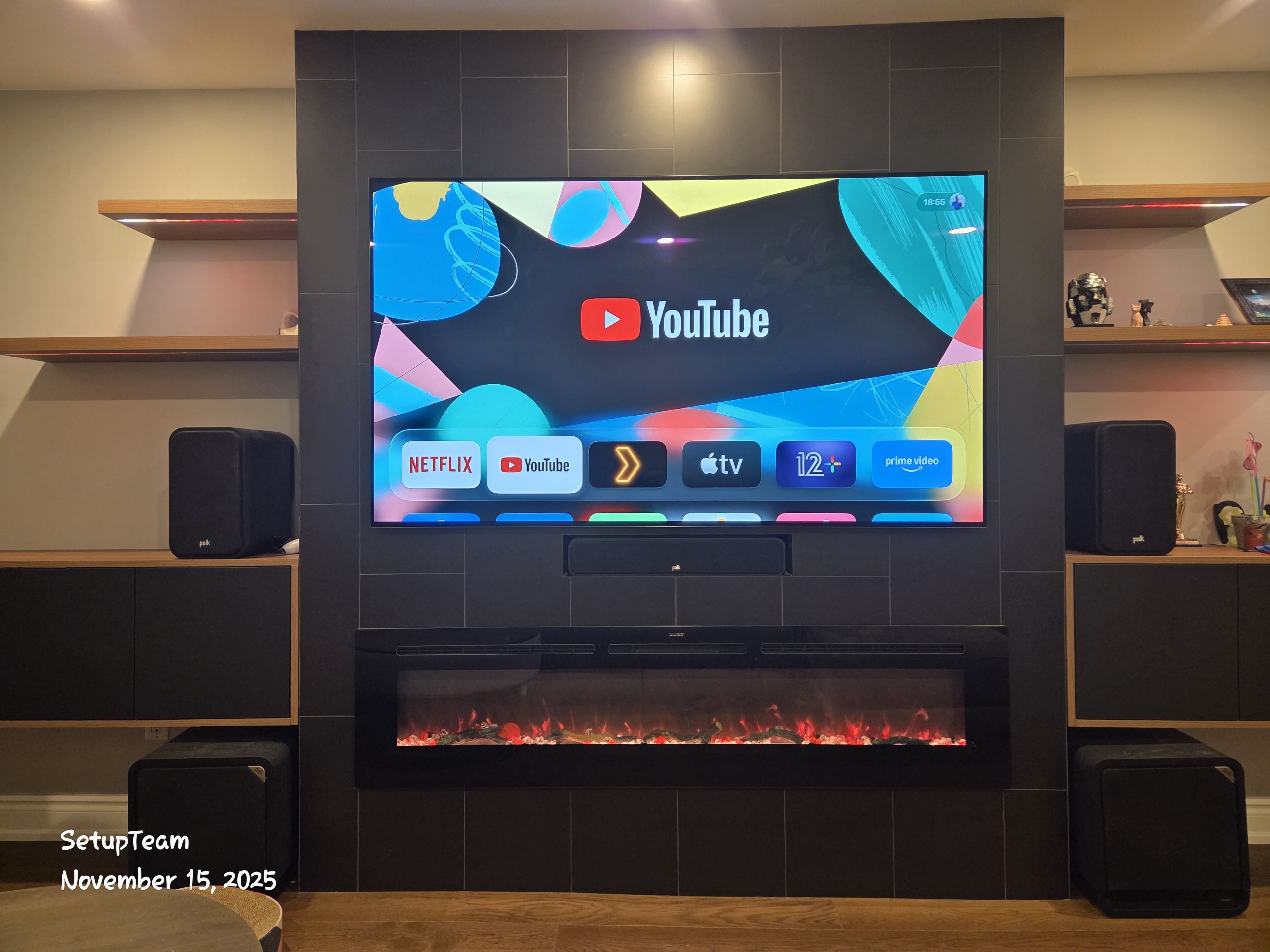
If you’d like to see how these systems look when properly integrated into real homes, the recent work gallery shows examples from installations across Toronto and the Greater Toronto Area.
Frequently Asked Questions
Is a soundbar actually better than TV speakers?
Significantly. Even a modest soundbar delivers clearer dialogue, wider stereo separation, and usable bass response that built-in TV speakers physically cannot produce. The improvement is immediately noticeable, especially with speech-heavy content like news and drama.
Is surround sound worth the investment for a living room?
For regular film, sports, and music listening, yes. Surround sound places discrete audio sources around the room rather than projecting everything from one point. Most people describe the difference as qualitative — a shift in immersion — rather than simply louder or fuller sound.
Do wireless surround systems like Sonos actually work well?
Modern wireless systems deliver genuine surround performance without in-wall wiring. Sonos uses proprietary synchronization to keep speakers aligned within microseconds. The key requirement is a stable home network — Wi-Fi dead zones or overloaded routers are the most common cause of performance issues.
When does a wired surround system make more sense than wireless?
During renovation or new construction, when speaker cable and conduit can be routed inside walls before drywall closes. Wired systems also support higher-power amplification, Dolby Atmos height channels, and have zero dependency on Wi-Fi — making them the better choice for dedicated cinema rooms.
Does speaker placement really matter that much?
It matters more than most people expect. Surround speakers placed at the wrong height or angle can collapse the spatial effect entirely. Subwoofer placement affects bass response dramatically due to room modes. Proper calibration and positioning often make a bigger difference than upgrading the equipment itself.
What does a soundbar installation typically cost?
Professional soundbar installation — including wall mounting, cable concealment, and HDMI ARC or eARC configuration — typically runs between $150 and $350 depending on complexity. The equipment itself varies widely by brand and model, from roughly $300 for an entry-level Sonos Beam to over $1,200 for a premium Arc.
How long does a surround sound installation take?
A wireless Sonos surround setup typically takes two to four hours including Trueplay calibration. A fully wired 5.1 or 7.1 system in an existing home may take a full day or more, depending on cable routing, drywall patching, and AV receiver configuration complexity.
Can I add surround sound to an existing wall-mounted TV?
Yes. Most surround upgrades happen after the TV is already installed. Wireless systems like Sonos are specifically designed for this — there’s no need to remove the TV or open walls. Wired retrofits are also possible but require more labour for in-wall cable routing.
Does virtual surround from a soundbar work as well as real surround?
Virtual surround uses DSP and wall reflections to simulate spatial audio. In small, symmetrical rooms with hard walls it can be convincing. In open-concept layouts, L-shaped rooms, or spaces with vaulted ceilings, the effect breaks down. Real surround speakers placed in correct positions will always outperform processing-based simulation.
Why does my TV sound worse after wall mounting?
Most TVs have downward-firing or rear-firing speakers that rely on the TV stand surface to reflect sound forward. When wall mounted, that reflective surface is removed and sound fires directly into the wall behind the panel — making audio noticeably thinner and more muffled. A soundbar or external speakers resolve this immediately.