

FT4 vs FT6 Cable for Ontario Offices: What's Required, and Where
FT4 is the everyday office cable. FT6 is the plenum-rated one. The difference that matters is not the network speed — it's whether your ceiling moves return air. Here's how to tell, in plain terms.

If you're cabling an Ontario office — a new tenant fit-out, a move, or just adding drops — someone will eventually ask whether you need FT4 or FT6 cable. It sounds like a small spec detail. It isn't. Choosing the wrong one can mean pulling cable back out after an inspection, and choosing the more expensive one everywhere wastes money. The good news: the decision usually comes down to a single question about your ceiling. This guide explains what FT4 and FT6 actually are, where each is typically used in an office, and who confirms the call — written plainly, with the official Ontario references at the end.
What is FT4 cable?
FT4 is the common general-purpose fire rating for office wiring.
FT4 is a flame-test rating defined by CSA and printed on the cable jacket. To earn it, a bundle of cable is mounted vertically on a tray and held in a strong flame (roughly 70,000 BTU/hr) for 20 minutes; the cable passes if the flame doesn't spread more than about 1.5 metres up the bundle. In practical terms, FT4 is the everyday rating for data and communication cable run through general building spaces — inside walls, in conduit, and through ceiling spaces that are not used to move building air. Most of the structured cabling in a typical office is FT4-rated unless something about the pathway pushes it higher.
What is FT6 cable?
FT6 is the plenum-rated cable, tested for low flame spread and low smoke.
FT6 is the higher rating. Instead of a vertical burn, FT6 cable goes through a horizontal flame-and-smoke test: the cable must keep flame spread short and produce very little smoke (there are strict limits on how dense the smoke can get). That smoke limit is the whole point. In a space used to move return air, smoke from a burning cable could be carried through the building, so the cable used there has to burn cleanly and quietly. That's why FT6 is the rating you'll see called for in return-air ceiling spaces. People often call it "plenum cable," and on imported product you may see the United States plenum marking CMP alongside or instead of FT6.

FT4 vs FT6 at a glance
Same job, different fire performance — and one is required where air moves.
| FT4 | FT6 | |
|---|---|---|
| Flame test | Vertical flame test | Horizontal flame & smoke test |
| Smoke limit | Not the focus of the test | Strict low-smoke limits |
| Typical use | General office pathways, conduit, non-air ceilings | Return-air (plenum) ceiling spaces |
| Common name | General-purpose / riser-grade | Plenum cable |
| U.S. equivalent marking | Roughly CMR-type | Broadly comparable to CMP |
| Can substitute for the other? | No — can't replace FT6 in a plenum | Yes — FT6 can be used wherever FT4 is allowed |
FT6 is the higher rating, so it can always stand in for FT4. The reverse is never true — FT4 cannot be used where FT6 is required.
Where each applies in an Ontario office
The rating follows the pathway, so walk the route the cable actually takes.
The same office can need different cable in different places. What matters is the space each run passes through, and in particular whether that space moves building air. Here's how the common office situations usually break down. Treat these as starting points to confirm, not final rulings — the building's mechanical design and the authority having jurisdiction settle the actual requirement.
Open office with a drop ceiling
A suspended ceiling on its own does not decide the rating. If the ceiling void is not used to move return air, FT4 in an acceptable pathway is often enough. The deciding factor is the air design above the tiles, not the tiles themselves.
Ceiling used as a return-air plenum
When the open ceiling space is used to carry return air back to the HVAC system, that space is a plenum. Cable run loose through it is generally expected to be FT6. This is the single most common reason an office needs plenum cable.
Conduit or enclosed raceway
Cable run inside conduit or a properly enclosed metal raceway is protected differently from cable lying loose in open air. This pathway can change what rating is acceptable, which is why some plenum runs are handled with conduit instead.
Riser / pathway between floors
Vertical runs that pass between floors have their own rules about firestopping and pathway. The cable rating and the way the floor penetration is sealed both matter, so vertical runs are worth confirming separately from the horizontal ones.
Server or network closet
The room where cable terminates — the rack, patch panel, and switches — is usually a general space rather than a plenum. Standard-rated cable is typically fine inside it, with the rating questions arising on the runs leaving the room.
Tenant improvement / fit-out
On a fit-out, the base building may already use ceiling-return air across the floor. Don't assume the demised suite matches the last one you wired. Check the air design for this space before ordering cable.
Not sure if your office ceiling is a plenum?
SetupTeam assesses the cabling pathway on site, coordinates with your building's air design, and runs clean commercial cable to the right rating — across Toronto and the GTA. We help confirm the situation; the inspector or AHJ makes the final call.
A simple decision table
Match the situation to the cable to ask about, and to who confirms it.
| Situation | Likely cable to ask about | Who should confirm |
|---|---|---|
| Drop ceiling, ducted return air (not a plenum) | FT4 in an acceptable pathway | Building manager / mechanical drawings |
| Open ceiling used as a return-air plenum | FT6 (plenum) | AHJ / electrical or building inspector |
| Run inside conduit or enclosed raceway | FT4 may be acceptable in the raceway | Installer + inspector |
| Vertical run between floors | Confirm rating + firestopping | AHJ / inspector |
| Inside the server / network closet | Standard-rated cable | Installer |
| Unsure how the ceiling moves air | Don't guess — confirm first | Building manager, then AHJ |
This table is a planning aid, not a code ruling. "Who should confirm" matters as much as the cable column — the authority having jurisdiction has the final say on any Ontario installation.
Cat6, Cat6A, and the fire rating are two different things
One describes speed; the other describes how the jacket behaves in a fire.
This trips people up constantly, so it's worth stating plainly: the network category and the fire rating are separate. Cat6 and Cat6A describe data performance — bandwidth, crosstalk, how fast and how far the cable carries a signal. FT4 and FT6 describe how the jacket behaves when exposed to fire. A single cable carries both: you can buy Cat6 FT4 and Cat6 FT6, or Cat6A FT4 and Cat6A FT6. So "Cat6 FT4" and "Cat6 FT6" are both genuinely Cat6 — the only difference between them is the jacket's fire rating. You pick the category for the speed you need and the FT rating for where the cable runs. They never substitute for each other.
Common mistakes we see in office cabling
Most rating problems come from assuming instead of checking.
- Assuming every drop ceiling needs FT6. A suspended ceiling is not automatically a plenum. If the ceiling void isn't used for return air, paying for FT6 everywhere is often spending you didn't need to.
- Assuming every office can use FT4. The opposite mistake. Plenty of commercial floors do use ceiling-return air — run loose FT4 through that space and it can fail inspection.
- Using residential-grade cable in a commercial ceiling. Cable bought for a house may not carry the rating a commercial air-handling space calls for. Match the cable to the space it's actually in.
- Ignoring the building's own rules. Many property managers and base-building specs state the cable rating and pathway they require. Skipping that step is how a clean install ends up getting pulled back out.
- Confusing the network category with the fire rating. Specifying "Cat6" says nothing about FT4 versus FT6. Both have to be stated.
How SetupTeam approaches office cabling
Assess the pathway first, then run clean cable to the right rating.
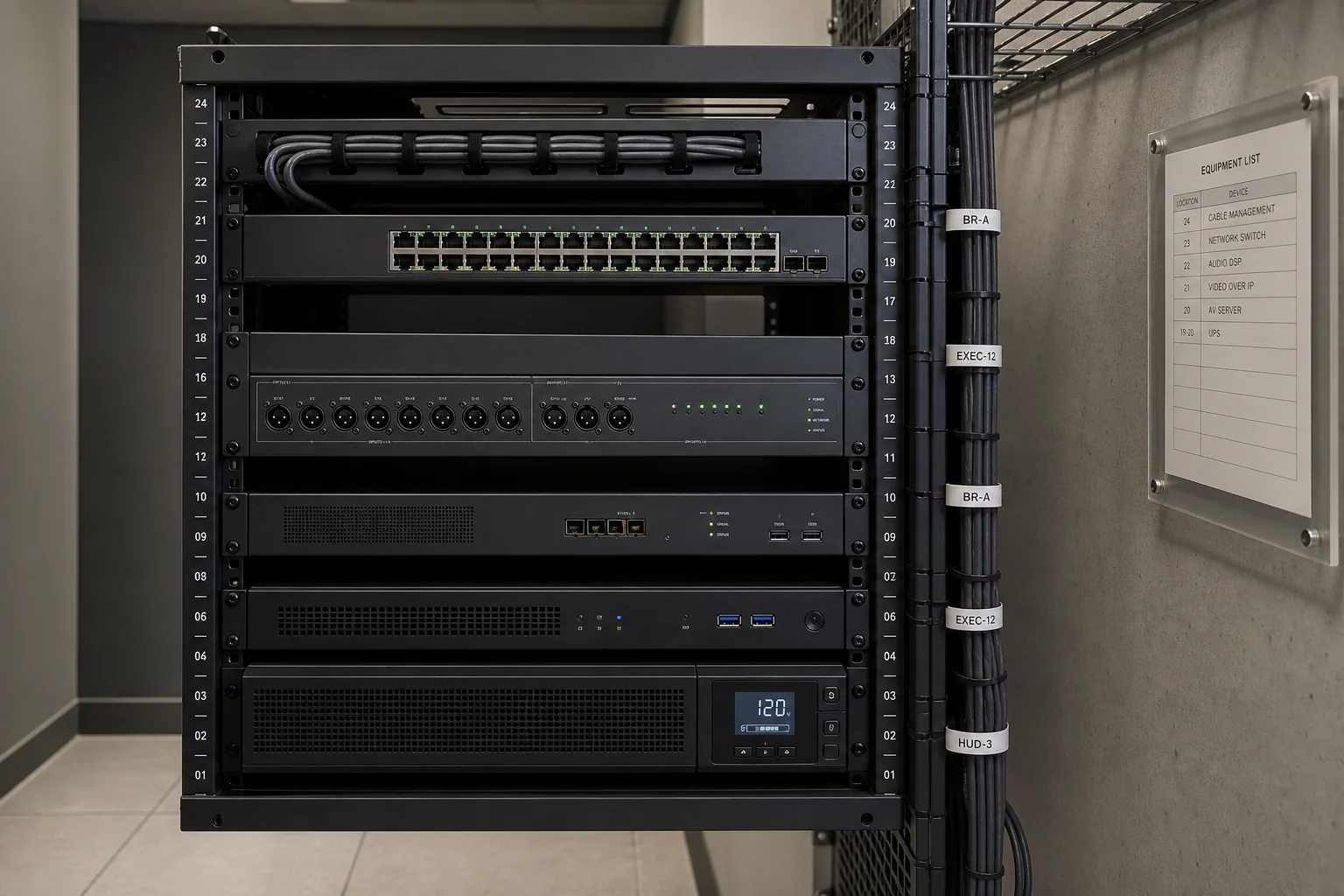
We're a low-voltage and commercial network cabling installer working across Toronto and the GTA, and our job on the rating question is practical, not authoritative. On a site assessment we walk the actual cable routes, look at how the ceiling and mechanical systems are set up, and coordinate with the building's requirements and your property manager — so the cable that goes in matches the space it runs through. From there we handle the install cleanly: tidy pathways, proper support, labelled terminations, and a tested result.
What we don't do — and no cabling contractor should claim to — is replace the people whose decision this actually is. We are not engineers, electrical inspectors, or the authority having jurisdiction, and we don't issue code rulings. On anything that turns on the building's air design or a code interpretation, the right move is to confirm with the building manager, the mechanical drawings, and ultimately the inspector or AHJ. Our role is to make that easy and to install to whatever the confirmed requirement is. If you're planning office commercial display or conference room AV work at the same time, getting the cabling pathway right up front keeps the whole project clean. For the bigger picture on what to run before the walls close, our guide to low-voltage wiring during a renovation or new build covers the planning side.
Frequently Asked Questions
8 answersBoth are CSA flame-test ratings printed on the cable jacket. FT4 passes a vertical flame test and is the common general-purpose rating for office wiring. FT6 passes a tougher horizontal flame-and-smoke test with low smoke limits, which is why it is the rating used for cable run through return-air (plenum) ceiling spaces.
Usually yes, in pathways that don't move building air. FT4 is commonly accepted for general office cabling such as cable run in conduit or in a ceiling that is not a return-air plenum. Where the same cable passes through a space used for environmental air, FT6 is generally required instead. The building design decides which case applies.
Where cable runs through a space used to move return air. FT6 is generally required where combustible-jacket data or communication cable runs through a plenum, such as a ceiling void used for return air. The requirement comes from the Ontario Building Code. Confirm whether your ceiling is an air-return plenum with the building manager or the authority having jurisdiction.
No — only when that ceiling space is used to move return air. Many offices use ducted return air, where the ceiling void is not a plenum and FT4 in an acceptable pathway is often sufficient. Whether the ceiling is a plenum is a building-design question, not something you can tell just by looking up at the tiles.
It can be either — they are separate properties. Cat6 describes the data performance of the cable; FT4 and FT6 describe the fire rating of its jacket. The same Cat6 or Cat6A cable is sold in both FT4 and FT6 versions, so you choose the network category and the fire rating independently, based on speed needs and where the cable runs.
Yes. FT6 meets a higher standard, so it can be used wherever FT4 is required. The reverse is not true: FT4 cable does not satisfy an FT6 plenum requirement. Some installers standardize on FT6 to avoid mixing cable types, though it costs more per foot.
They're the U.S. equivalents, not the Canadian spec. CMP (plenum) and CMR (riser) are United States NEC markings. In Canada, cable is specified by its FT rating. FT6 is the Canadian plenum rating broadly comparable to CMP, and FT4 is the common general rating you may see alongside CMR-type markings. For Ontario work, specify by the FT rating.
The authority having jurisdiction — usually the local inspector. The decision is based on the building design and how the ceiling and mechanical systems are set up. Your building manager, the mechanical drawings, and your cabling installer help confirm the situation, but the inspector or AHJ has the final say.
Sources and technical references
Official Ontario and Canadian references behind this guide.
The rating requirements above come from Ontario's building and electrical codes, not from any one supplier. The codes and test standards themselves (CSA C22.1, CAN/ULC-S102.4, and the full Ontario Building Code text) are published by CSA Group, ULC Standards, and the Province of Ontario, and several are sold rather than posted free online. The accessible official and credible references are listed here so you can read the source material directly.
- Ontario Electrical Safety Code (ESA). Confirms the Code is the Canadian Electrical Code Part I plus Ontario amendments, administered by the Electrical Safety Authority — esasafe.com/role/oesc.
- Ontario Regulation 164/99: Electrical Safety Code (Ontario e-Laws). The regulation that adopts the Canadian Electrical Code in Ontario — ontario.ca/laws/regulation/990164.
- Ontario Regulation 332/12: Building Code (Ontario e-Laws). The Ontario Building Code, which sets the requirements for wires and cables in plenums and air-handling spaces — ontario.ca/laws/regulation/120332.
- City of Markham Builder Tip No. 16 — Electrical Wires and Cables. A municipal summary mapping FT1, FT4, and FT6 to the Ontario Building Code plenum provisions — markham.ca (PDF).
- National Building Code of Canada 2020 (NRC). The model code published by the National Research Council that provincial building codes are based on — nrc.canada.ca.
- CSA flame-test ratings (technical reference). A plain-language explanation of the FT1–FT6 test methods and where each applies — sycor.com.
This guide is general information, not code, legal, or engineering advice. Code provisions are updated periodically and are interpreted by the authority having jurisdiction for each specific building. Always confirm the requirement for your project with your building manager and the local inspector or AHJ before ordering or installing cable.
Cabling an Ontario office? Let's get the pathway right.
SetupTeam runs clean commercial network cabling and coordinates with your building's air design so the cable matches the space — FT4 or FT6, run properly and tested. We help confirm the situation; the inspector or AHJ makes the final call.

