

New Installation
Clean-slate Control4 design and programming for new builds and finished estates: AV, Lutron lighting, motorised shading, climate, security, and outbuilding integration under one interface.
Tell Us About Your Project
We'll Be in Touch
Your request has been received. A member of our team will contact you within 24 hours to discuss your project.
Book an Appointment
Select a date above to see available times.
This is a request, not a confirmed booking.
We’ll call to confirm details and provide an estimate.
By submitting this form, you agree to our Terms of Service and Privacy Policy, and to receive emails from SetupTeam Inc. about your request, plus offers and promotions. You can unsubscribe at any time.
We’re holding your preferred time and will contact you shortly to confirm the details, scope of work, and timing. We’ve sent you a text and an email to confirm we received it.
Need faster service? Call or WhatsApp (647) 464‑0606
Acreage, outbuildings, and long cable runs decide what a system has to reach out here. We design new installations, take over orphaned systems as your authorized dealer, and troubleshoot on site across King City, Nobleton, Schomberg, Kettleby, and the Township of King.
Control4 work in King Township is not a single project type. Large-lot estate properties, equestrian farms, century-home restorations, and rural luxury builds on the Oak Ridges Moraine's western edge produce three very different briefs, and which one applies depends on the age and current status of whatever technology infrastructure already exists on the property.
The first is a new installation: a recently completed build or a finished estate that has never had a structured smart home system, where the brief is to design, specify, and program a Control4 system from scratch. This is the clean-slate engagement on properties across Nobleton and Schomberg, and here in King City itself, where a high-spec new build is ready to have its AV, lighting, climate, security, and outbuilding systems brought under unified control.
The second, and the situation we encounter most often in the established estate tier of King Township, is a system takeover. This part of York Region saw a significant wave of Control4 installations between roughly 2000 and 2015, driven by the municipality's high-net-worth property owners who were early to invest in whole-home automation. Boutique integrators who specialized in rural luxury builds installed many of those systems, and a number of those firms no longer operate. The result is a meaningful cohort of estate homes here and in Nobleton and the surrounding concession roads, where the Control4 hardware still runs, but the authorized dealer is unreachable or gone.
The third is troubleshooting: an existing system that has degraded from a previously working state. Control4 systems on large rural and semi-rural properties in King Township face a specific set of failure modes: rural ISP reliability, wireless coverage across large lots, and long cable runs between buildings that suburban installations do not have to solve. These are addressed in detail below.
SetupTeam is an authorized Control4 dealer and handles all three briefs. For the complete picture of our Control4 services see our Control4 installation hub page.
Clean-slate Control4 design and programming for new builds and finished estates: AV, Lutron lighting, motorised shading, climate, security, and outbuilding integration under one interface.
Formal dealer-of-record transfer through Control4's authorized channel, restoring Composer Pro access for systems whose original integrator has closed or stopped responding.
Diagnostic and remediation visits for systems that have degraded: rural ISP, Zigbee mesh, long cable runs, and outbuilding integration failures resolved in a single structured visit.

You complete a formal dealer-of-record transfer to an authorized Control4 dealer, and that transfer is the only way to regain full programming access and ongoing service capability for your existing system.
The situation is more common here than most homeowners realize, and it has a specific cause rooted in this market's history. The estate and equestrian properties across King Township, including Nobleton and the surrounding concession-road communities, began adopting Control4 in earnest around 2000 to 2005, earlier than many GTA suburban markets, because the high-net-worth owners here were both willing and able to invest in premium whole-home automation before it became mainstream. The firms that installed those systems were mostly boutique integrators: specialists who operated at the top of the residential AV market and built their businesses around a small roster of high-value rural and estate clients. Several of those operations have since closed, merged into larger AV companies, or stopped serving residential Control4 accounts.
When the original dealer disappears from a King Township estate, the problem is precise and well-defined. Control4 restricts its programming environment, Composer Pro, to authorized dealers only. A general technology contractor, an IT service company, or the homeowner directly cannot use it for any substantive modification. Without an active dealer of record, no one can meaningfully reprogram your system, integrate new devices at the driver level, or add, rename, or rebuild a custom scene. Firmware updates cannot go through the correct process, and manufacturer warranty support is unavailable without a registered dealer on the account.
A dealer-of-record transfer is not a complicated administrative process, though it does require an authorized dealer to initiate it through Control4's licensed channel. The steps are: confirming your system details and the current registration status; initiating the formal transfer with SetupTeam as the incoming dealer of record; completing an on-site visit at your property to confirm system access, assess current stability, and review the project file; and then assuming full authorized service responsibility going forward. The on-site portion takes about two to four hours, depending on system complexity and the number of controlled zones.
Once the transfer is complete, SetupTeam holds the dealer-of-record designation and can make any programming change, add any device, rebuild any scene, or manage firmware updates, with no further administrative step required. If a company that has since closed installed your Control4 system, or you can no longer reach the original integrator, a dealer-of-record transfer is the first and necessary step before any other service or upgrade work can begin.

The failure modes we encounter on King Township properties differ from those we see on suburban installations in Vaughan or Richmond Hill, not because the Control4 platform works differently here, but because the physical environment and infrastructure conditions of rural estate properties create challenges that do not exist on a 60-foot suburban lot.
Rural ISP reliability is the first and most distinct factor. Many properties here rely on satellite internet, increasingly Starlink, or on rural Bell service with less redundancy and more intermittent outages than urban cable or fibre infrastructure. Control4's remote access platform (OvrC and Control4 Connect) and its real-time scene execution logic both depend on a stable, continuously connected WAN. When the internet goes down on a Starlink-served estate, even briefly during satellite handoff events or weather, OvrC remote access drops and any Control4 integrations that rely on cloud-based drivers can behave unpredictably. For many properties Starlink is the best available option, so the fix is configuring the Control4 system and network architecture to handle WAN interruptions cleanly. Our team handles network installation in King City as a connected service and configures the network layer alongside the Control4 system, treating them as one engagement.
Wireless coverage across large lots is the second challenge. A Zigbee mesh designed for a 4,000-square-foot suburban home does not reliably cover a 9,000-square-foot estate on a 5-acre lot, and it does not reach a coach house or stable 150 metres from the main residence. When a property is too large or too spread out for the existing Zigbee mesh, devices at the periphery, a keypad in the mudroom, a light switch in the far wing, a sensor near the pool house, drop in and out of communication with the controller. These symptoms look like malfunctioning hardware. The actual remedy is Zigbee mesh auditing and strategic repeater placement; outbuildings at significant distances get a secondary network-connected controller at the remote structure instead of a stretched mesh across open ground.
Long cable runs are the third issue, and one that is unique to estate-scale and rural properties in practice. A 30-metre HDMI cable run loses signal integrity without an active extender. A 100-metre audio distribution run has impedance and attenuation characteristics that require proper line drivers. Ethernet cable runs exceeding 90 metres require either a switch at the midpoint or, for cross-building runs on a King Township property, a fibre backbone with media converters at each end. We encounter Control4 deployments here where HDMI signal runs over cable lengths that cannot work at the resolution the homeowner expects, and where the system has been degrading slowly for years without anyone identifying the cause.
Outbuilding integration failures make up the fourth category. Control4 systems on King Township estates frequently include, or were intended to include, control of a coach house, guest suite, pool house, stable, or barn. The complexity increases when the secondary structure is on its own power circuit, has no structured wiring connection to the main house, or was added to the project after initial installation using consumer-grade network equipment. Resolving it requires a structured on-site assessment, a clear decision about whether the outbuilding needs its own network-connected controller, and a rebuild of the integration in Composer Pro with a stable infrastructure foundation behind it.
Local network and Control4 architecture configured to handle satellite handoff events and rural Bell interruptions without cascading scene failures.
Repeater placement modelled to the actual property footprint. Outbuildings beyond reliable mesh range get a secondary controller instead of a stretched mesh.
HDMI extenders, audio line drivers, and fibre backbone with media converters for cross-building Ethernet, sized to the run and not a suburban checklist.
Outbuilding integration rebuilt in Composer Pro with proper network infrastructure: coach houses, stables, pool houses, and guest suites brought into one system.
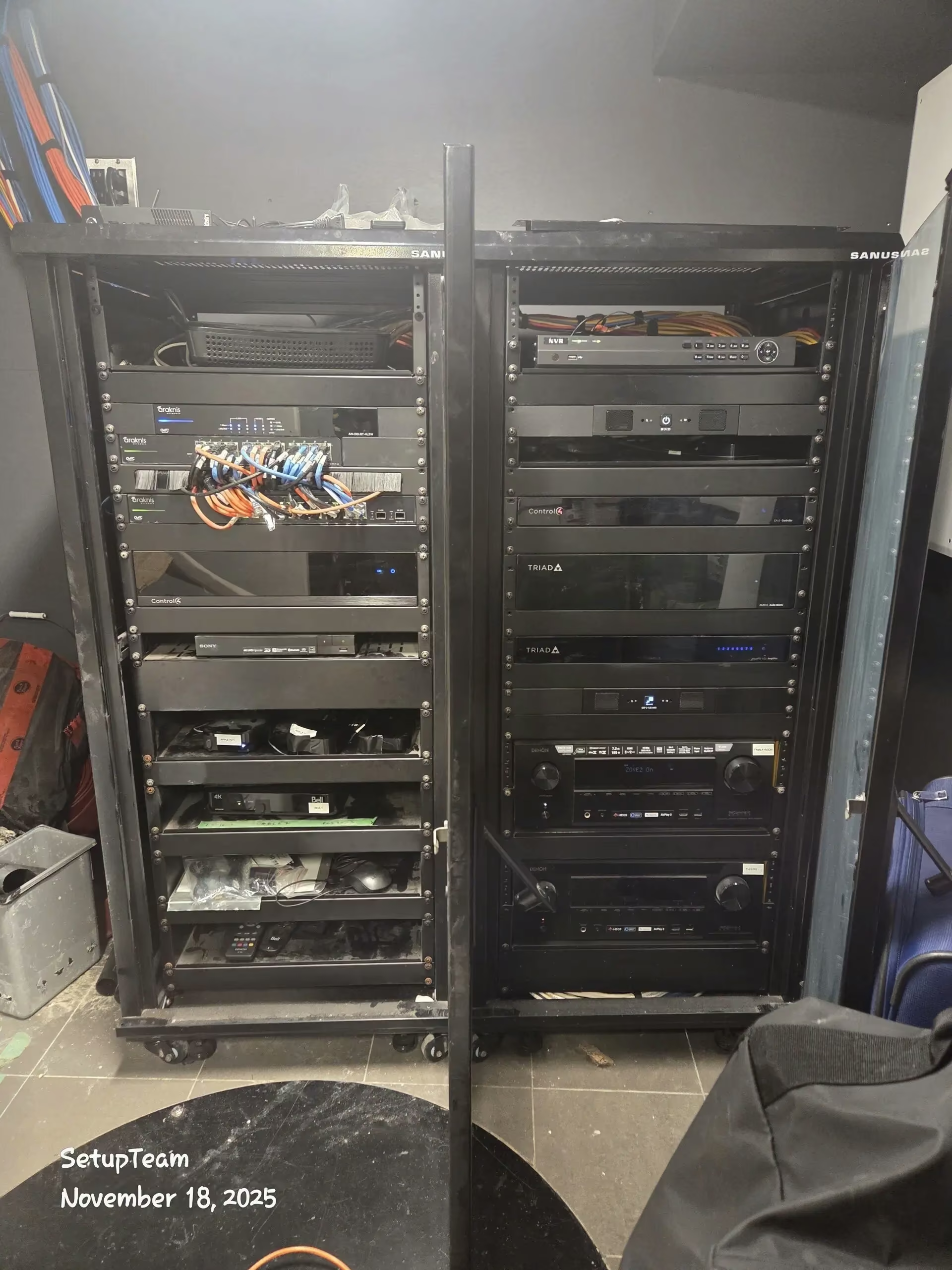
Talk to an authorized Control4 dealer that handles new installations, dealer-of-record transfers, and on-site troubleshooting in-house, across the main residence, coach houses, stables, and grounds.
King Township is not a suburban city with large houses. It is a rural municipality, one of the least densely populated in York Region, where the dominant property type is a large-lot estate, working farm, or equestrian facility on anywhere from one to twenty acres of land. That physical character creates Control4 requirements that differ from those of any other market in the GTA.
The village core is the township's administrative centre and one of its most concentrated areas of high-value residential development. Estates here tend toward transitional or traditional architecture: stone and stucco facades, covered entries, three- and four-car garages, properties with a main residence, a pool house, and often a detached coach house or garage suite. A Control4 brief in this village core covers the main house in full: Lutron lighting and motorized shading throughout, Sonos distributed audio, home cinema in a dedicated media room, security camera integration, plus the outbuildings and any outdoor AV for a covered terrace or pool area. Gate automation is standard here; driveways are long, and electronic gate systems tied to the Control4 interface are the norm in this price tier.
Nobleton is King Township's second-largest community, with a different character: the properties here tend toward larger rural acreage, with more working farms and equestrian facilities mixed in among the luxury residential builds. The Control4 scope on a Nobleton estate frequently extends beyond the main residence: barn audio, stable intercom, exterior cameras covering paddocks and riding arenas, and sometimes a separate guest residence or farm manager's quarters with its own AV. These integrations require a technician who has seen an equestrian property's infrastructure, not one adapting a suburban project checklist on the fly.
The equestrian character of King Township is one of the defining features of the municipality's identity and its property market. The practical implications for a Control4 installation are real: speakers in the grooming barn that play music on the same Sonos system as the main house; an intercom panel at the stable entrance that connects to the kitchen keypad; exterior security cameras covering the paddock and indoor arena feeds accessible on any Control4 interface; and a gate system that can be opened from the stable office, the farmhouse kitchen, or a smartphone anywhere in the world.
Schomberg is the northern community, positioned on the Schomberg River with a smaller-town character and a lower density of luxury estate development. Properties here tend to be larger in acreage, with more working agricultural land, and the brief often reflects that: more emphasis on outdoor coverage, outbuilding integration, and estate-scale wireless infrastructure planning. Kettleby, Lloydtown, Pottageville, and the properties along the township's numbered concession roads represent the most rural tier of the market, where a Control4 system might have been installed a decade ago by an integrator who no longer operates, or where a new owner of a heritage farmhouse wants to integrate contemporary smart home technology into a structure with no existing low-voltage infrastructure.

Control4's defining capability is unifying every technology system in a home, and on a King Township property, that scope extends well beyond the main residence to include outbuildings, grounds, and structures that do not exist in suburban installations.
Inside the main residence, a Control4 deployment covers Lutron RadioRA lighting and motorized shading integrated with time-of-day and occupancy scenes; Sonos installation and distributed audio throughout the house, extended to outdoor zones on a covered terrace or pool area; home cinema in a dedicated media room, with a projector or large-format display, Dolby Atmos processing, screen and shading automation, and scene programming that triggers the full room setup from a single keypad button; security cameras and video doorbells accessible on every Control4 interface; and climate control tied to daily routines and room-level occupancy instead of a shared thermostat schedule.
On a property with outbuildings, which describes most of the estate tier, Control4 extends further: a coach house or guest suite with its own AV system and lighting scenes, controlled from both the outbuilding itself and the main house interface; a pool house with distributed audio, climate, and a camera feed to the main residence; and, for equestrian properties, a set of integrations specific to this market, including speakers in the grooming barn and tack room on the same Sonos source as the kitchen, an intercom panel at the stable entrance that rings directly to the main house keypads, security cameras covering the paddock, riding arena, and stable yard, and a gate system tied to the Control4 controller so the estate gate can be opened from any interface, from a Control4 mobile app, or on an automated schedule for staff arrival and departure.
Gate automation is common across the township's estate and equestrian properties. Long driveways, often 100 to 300 metres in length, make manual gate operation inconvenient, and the Control4 integration provides something a standalone gate controller does not: automation logic that can open the gate at a scheduled time, notify a keypad when the gate is triggered by a visitor call button, and lock down the entire property perimeter in a single 'Away' scene. For properties with heritage farmhouse structures, Control4 also brings modern convenience into a building with limited existing infrastructure: we retrofit wireless Control4 and Lutron devices into heritage interiors without running new cable through finished walls.
RadioRA lighting and motorised shading on time-of-day and occupancy scenes: main residence, coach house, and outbuildings on one logic layer.
Sonos across the house, covered terrace, pool area, grooming barn, and tack room: single-source whole-property audio without separate zones to manage.
Projector or large-format display, Dolby Atmos processing, screen and shading automation, and one-button scene programming from the main keypad.
Estate gate integrated with Control4, opened from any keypad, the mobile app, or on an automated schedule. Included in 'Away' and 'Goodnight' scenes.
Audio in the grooming barn, intercom at the stable entrance, paddock and arena camera feeds, accessible on every Control4 interface in the main house.
Outbuilding AV, lighting scenes, climate, and camera feeds tied back to the main residence, controlled from either location with no parallel systems.
Every project, new installation, dealer takeover, or troubleshooting visit, follows four structured phases, and the scope of each phase reflects the specific demands of rural estate properties instead of a suburban project template.
We survey every building that will be connected, main house, coach house, pool house, barn, guest suite, for network, low-voltage routes, and ISP conditions before any design work begins.
Hardware specification, system architecture, scene design, wiring scope, and outbuilding integration plan, or, for takeovers, dealer-of-record transfer plus a complete project-file assessment, documented before work begins.
Network and Wi-Fi optimization and network reliability planning, structured wiring, controller install in every building, and full Composer Pro programming of every scene, gate logic, barn intercom, and outbuilding AV included.
Every scene, every control point, every building tested under actual-use conditions. Walkthrough at each location, OvrC remote management confirmed, every cable labelled for any future technician.
On new builds and major renovations, we participate before walls close and coordinate with the general contractor, landscaper, and electrician on infrastructure routing, rack room placement, and conduit runs, both inside the main house and between buildings across the property. For takeovers, the on-site assessment covers which devices are registered and healthy, which are offline or misconfigured, what programming cleanup is needed, and whether any hardware is at end-of-life. Nothing proceeds on a verbal description or a best-guess estimate.
A focused new install in King City runs $12,000–$25,000, a mid-range estate deployment $25,000–$55,000, and a full estate deployment starts at $55,000 — property scale matters more here than in a suburban home. We quote every project after a full site consultation and infrastructure survey instead of from a standard package, because the scope of an estate installation cannot come from a floor plan alone.
Half-day to full-day diagnostic. Estate properties with multiple buildings may require a full day before a separate remediation visit. Hardware replacements quoted separately after diagnosis.
Starts with system assessment and the formal transfer. The project-file condition sets the programming cleanup or rebuild scope once we restore Composer Pro access; we assess first and quote before work proceeds.
AV control and lighting scenes in the main residence with a basic outbuilding tie-in for a coach house or pool house, usually $12,000–$25,000 installed, depending on zones and network state.
Lutron lighting and shading throughout the main residence, Sonos audio, home cinema, gate automation, and outbuilding AV for one or two secondary structures, usually $25,000–$55,000 installed.
Comprehensive Lutron, whole-estate audio, cinema, security, equestrian barn and intercom integration, gate automation, full Composer Pro programming across all buildings: starts at $55,000.
Multiple barns, outdoor arena PA, Olympic-grade stable infrastructure, quoted individually following a thorough site visit. Troubleshooting, takeover, and new install scopes priced separately.
We quote all pricing transparently before work begins. Troubleshooting, takeover, new installation, and outbuilding integration scopes are each priced separately so you know exactly what each component costs before approving anything.
Selected from 530+ Google reviews: three recent estate, equestrian, and troubleshooting projects across the township, Stephen in King City, Margaret in Nobleton, and David in Schomberg.
We had a Control4 system that was installed during our build in 2011 — the original integrator hasn't been reachable for years. SetupTeam did the dealer takeover, completely rebuilt the project file, and extended the system to our coach house and gate. The whole property finally works as one system. Exceptional work, and they clearly understood the scale of what we needed.
Our equestrian property had a Control4 system in the main house but nothing in the stable or arena. SetupTeam designed an extension covering the barn, tack room, and outdoor arena speakers — all running through the same Control4 app. The barn intercom to the kitchen was a specific request and they delivered it exactly right. Very professional, understood what an equestrian property actually requires.
Our Control4 system was constantly dropping devices — we assumed it was the hardware getting old. SetupTeam came out, diagnosed the real problem in about an hour: the Starlink setup wasn't configured correctly for OvrC remote access, and the Zigbee coverage wasn't reaching the far wing of the house. They fixed both the network and the Zigbee gaps in the same visit. Has been solid ever since.
Yes, this is one of the most common requests we receive from King City and King Township homeowners. If the company or individual that installed your Control4 system has closed, stopped responding, or is otherwise unreachable, SetupTeam can complete a formal dealer-of-record transfer through Control4's authorized process. This makes SetupTeam your registered service provider, which is the only way to restore full Composer Pro programming access going forward. The process involves confirming your system's registration status, initiating the transfer through Control4's authorized channel with SetupTeam as the incoming dealer, completing an on-site visit at your property to verify system access and current stability, and then assuming full ongoing service responsibility. The on-site portion typically takes two to four hours on an estate property. Once the transfer is complete, we can make any programming change, add any device, rebuild any scene, or manage firmware updates for your system.
Yes, but it needs proper configuration to perform reliably. Many King Township properties use Starlink as their primary internet service, and Control4 systems can work well on Starlink when the network architecture accounts for its characteristics. The key considerations are: Starlink's brief interruptions during satellite handoff events can cause OvrC remote access to drop and some cloud-dependent device drivers to behave erratically unless the Control4 system and local network are configured to handle WAN interruptions; the Starlink router should be placed in bypass mode with a managed local router handling DHCP and Control4 device IP assignment; and static IP reservations for all Control4 devices must be configured on the local router instead of relying on Starlink's DHCP assignment. We handle this network configuration as part of every Control4 installation on Starlink-served properties as a standard part of our estate-installation process.
Yes, this is one of the most common integration requests we receive from equestrian and estate properties in King Township, and one of the areas where SetupTeam's experience with multi-building properties directly applies. Control4 can manage audio, intercom, lighting scenes, security cameras, and climate in a barn, stable, tack room, coach house, guest suite, or any other outbuilding, all from the same app and keypads used to control the main house. The technical approach depends on the distance between buildings and the existing infrastructure: for structures within 90 metres with an existing network connection, the outbuilding can be integrated as a zone extension of the main system; for structures at greater distances or with no existing network connection to the main house, a secondary network-connected controller in the outbuilding is usually the right approach, with the two controllers communicating over a fibre backbone or extended network link.
On King Township estate properties, the most common root causes are Zigbee coverage gaps across large square footage, and outbuilding devices that are beyond the reliable range of the Zigbee mesh anchored at the main residence controller. Control4's Zigbee protocol has a practical mesh range: devices at the periphery of a large estate, or in a barn or coach house separated from the main house by open ground, often sit outside reliable Zigbee coverage. The symptoms look like hardware failure: keypads stop responding, zones drop, the app shows devices as offline. The actual fix is a Zigbee mesh audit, strategic placement of repeater devices at intermediate points, and, where outbuildings are involved, a decision about whether a secondary network-connected controller is the right architecture. Network misconfiguration and ISP-related WAN instability are also common causes that can produce similar symptoms. We diagnose across all layers, Control4 software, Zigbee mesh, and network infrastructure, in a single site visit instead of treating them as separate problems.
Most systems from that era are still supportable with the right authorized dealer and proper programming tools, but they likely need attention. Control4 has released several significant OS updates since 2005, and systems that have not had active dealer management through those transitions often have accumulated driver conflicts, outdated firmware on individual devices, or project file structures that are incompatible with current OS versions. Older hardware, particularly first-generation EA controllers and some legacy keypads, may also be at or approaching end-of-life and warrant replacement with current-generation equipment. We assess the hardware and project file in a single visit: hardware that is healthy is retained and updated; hardware that is failing is replaced and quoted transparently before any work begins. Many systems from this era are in better condition than their owners expect: they have been running without active management and need a proper audit and programming update instead of a full replacement.
Yes, estate gate automation is one of the most common Control4 integrations on King Township properties, and it is one of the integrations that benefits most from being part of a unified Control4 system instead of a standalone gate controller. When the gate is integrated with Control4, it can be opened from any keypad in the house, from the Control4 mobile app anywhere in the world, or automatically on a schedule for staff or service arrival times. A video doorbell or intercom panel at the gate entrance can ring through to any Control4 touchscreen or interface in the main residence. The gate's open or closed status appears on every Control4 interface, and the gate can be included in security scenes: a single 'Away' or 'Goodnight' scene can lock the house, arm cameras, and close the gate simultaneously. The integration requires a gate controller with a supported Control4 driver and proper network connectivity; we specify and install both as part of the Control4 project.
Pricing varies by project type and scope, and every project in King Township is quoted after a full site visit and infrastructure survey. A focused new installation, AV control, lighting scenes, and outbuilding tie-in for a coach house or pool house, typically runs $12,000 to $25,000 installed. A mid-range estate deployment with Lutron lighting and shading, Sonos distributed audio, home cinema, gate automation, and outbuilding AV for one or two secondary structures typically ranges from $25,000 to $55,000. A full estate deployment across the main house and all outbuildings, comprehensive Lutron, distributed audio, cinema, security, equestrian barn and intercom integration, gate automation, and full Composer Pro programming, typically starts at $55,000 and scales with property scope. Dealer takeover and troubleshooting are quoted separately after the on-site assessment.
Scope and site conditions determine the timeline more than the device count. A focused installation in a finished residence, AV, lighting scenes, no outbuildings, typically takes two to three days including programming. A mid-range system with Lutron integration, distributed audio, cinema, and outbuilding tie-in runs about four to six days across multiple visits. A full estate deployment involving multiple buildings, new cable infrastructure between structures, equestrian integrations, and comprehensive Composer Pro programming is scoped individually and often spans several visits across a longer project timeline, particularly on new construction projects where we participate across multiple phases. For pre-wire engagements on new builds, we coordinate directly with the general contractor and interior designer and confirm that our rough-in work aligns with the architectural drawings before any walls close.
Yes, multi-building Control4 deployments are a standard part of our work on King Township estate properties, and the architecture for doing it correctly is well-established. The approach depends on the distances involved and the existing infrastructure between buildings. For structures within 90 metres with existing Ethernet connectivity, outbuilding devices can be integrated as zone extensions of the main house controller: Zigbee repeaters positioned at appropriate intervals maintain device communication, and audio distribution runs to the outbuilding on the existing or new low-voltage cabling. For structures at greater distances, a barn 200 metres from the main house, or a stable on the far side of a paddock, the right architecture is a secondary network-connected Control4 controller at the remote structure, with the two controllers linked via a fibre backbone run between buildings. Both structures appear unified in the Control4 app and respond to the same scenes and keypads as if they were a single system.
Yes, we serve all of King Township for Control4 installation, dealer takeovers, and troubleshooting, including King City, Nobleton, Schomberg, Kettleby, Lloydtown, Pottageville, Laskay, Kinghorn, and properties along the township's numbered concession roads. Estate and rural properties are a regular part of our project mix; we are familiar with the infrastructure considerations, long cable runs, multi-building deployments, rural ISP conditions, that come with the territory. Site visits are usually available within the week. We also serve the surrounding York Region communities of Aurora, Newmarket, Vaughan, and Richmond Hill for Control4 work.
SetupTeam serves communities across the Greater Toronto Area.
Whether you are commissioning a new installation, dealing with an orphaned system after your original integrator closed, troubleshooting zones that have been degrading for months, or extending Control4 to a barn, coach house, or equestrian facility, book a site visit and we will start with a full property assessment before recommending anything.
Residential & Commercial AV Services

