

The Right TV Height for Every Room: What 15 Years of Installations Has Taught Us
The 42-inch rule sounds simple — but it doesn't account for how people actually watch TV.
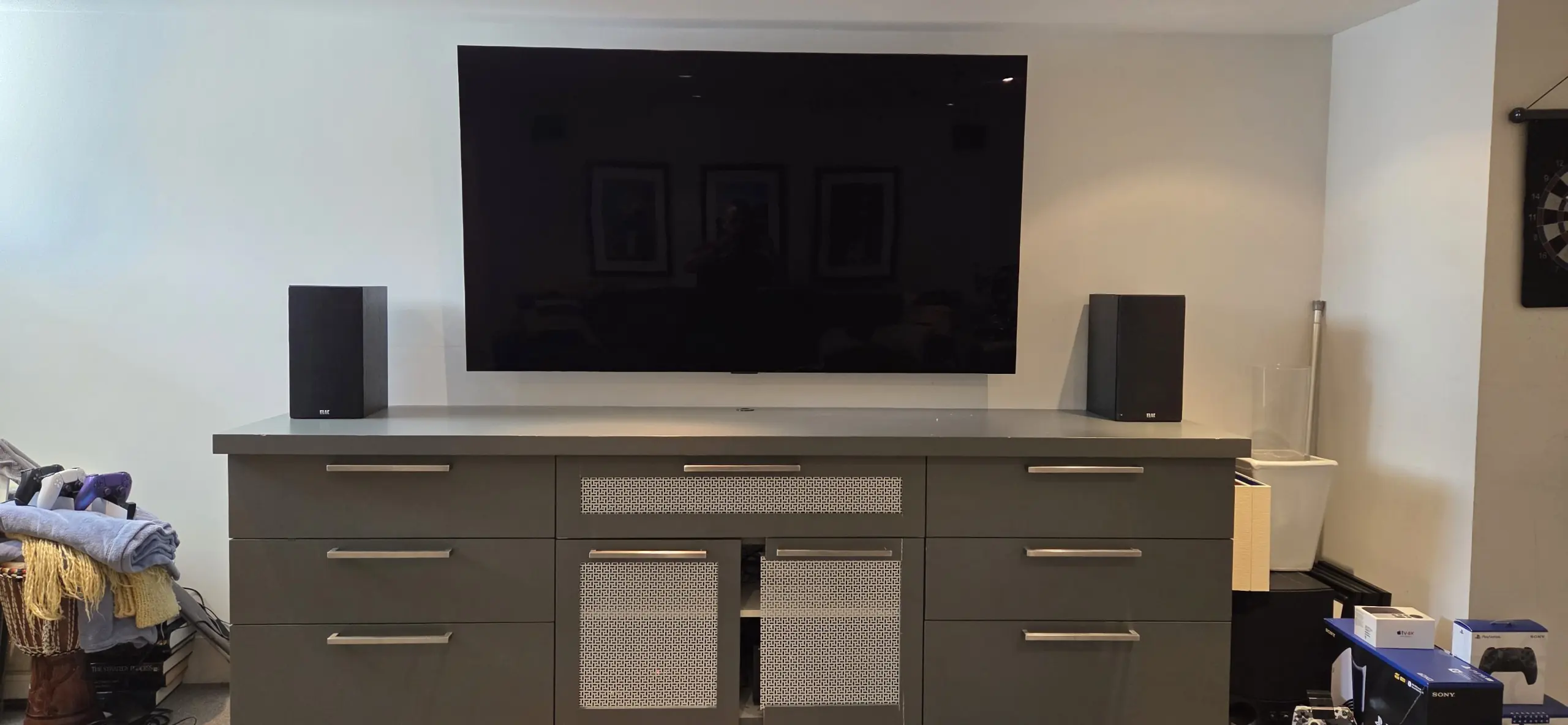
Every week, we walk into a home where the TV is mounted six inches too high. The homeowner noticed it the first night — a slight tilt of the head, a vague neck tension by the second episode — but assumed it was normal. It isn't. And the measurement that put it there was almost certainly the 42-inch rule: mount the centre of the screen at 42 inches from the floor, align it to seated eye level, done. That formula isn't wrong, exactly. It's just built for a posture most people abandon within ten minutes of sitting down to watch television.
Quick Answers
How high should a TV be mounted on the wall?
For most living rooms, mount the TV so your eye level — in your actual relaxed watching position, not sitting bolt upright — aligns with the bottom third of the screen. In practice, this places the TV a few inches higher than the standard 42-inch centre-to-floor formula, which better accounts for the slight recline most people settle into.
How high should a bedroom TV be mounted?
It depends entirely on how you watch. If you sit up against the headboard, apply the same bottom-third rule as a living room. If you watch lying flat, mount the TV as high as the room allows — roughly 18 inches below the ceiling in a standard 8-foot room — with a tilt mount angling the screen toward the bed.
Why does my neck hurt after watching my wall-mounted TV?
In most cases, the TV is mounted too high. The standard 42-inch rule assumes you sit upright, but most people recline while watching, which shifts their gaze upward. If the TV is at the wrong height for your actual relaxed position, your neck compensates — and strain builds over a viewing session.
Should I mount my TV above the fireplace?
It's workable, but it requires a tilt mount. Fireplace mantels typically sit 50 to 54 inches from the floor, putting the TV well above comfortable eye level for seated viewers. A downward tilt of 10 to 15 degrees recovers most of the comfort. A fixed mount above a fireplace causes neck strain for anyone watching more than a few minutes.
The 42-Inch Rule — Correct in Theory, Incomplete in Practice
The 42-inch standard has been the default recommendation for TV mounting height across North America for years. It comes from a reasonable premise: the average adult's eyes, seated upright on a standard sofa, land somewhere between 40 and 44 inches off the floor. If the centre of the screen matches that height, you're looking straight ahead. No neck tilt, no strain, no distortion from an off-axis viewing angle.
The problem is the phrase "seated upright." On a couch, that position typically lasts until the opening credits finish.
How People Actually Watch TV
Real watching isn't a posture — it's a drift. You sit down straight, you settle into the cushions, and within a few minutes your torso has reclined somewhere between 10 and 20 degrees. Your lower back meets the back of the couch. Your shoulders drop. And your eyes, which were at 42 inches when you sat down, are now angled slightly upward — because your head has tilted back with the rest of you.
Deep sectionals and low-profile sofas make this more pronounced. A plush sectional can drop your seated eye level by several inches compared to a firm upright chair, which shifts the whole geometry of the room. The TV that looked right when you were sitting forward feels like it's hanging near the ceiling once you actually relax.
The Reclining Variable Nobody Accounts For
When you recline — even slightly — your natural gaze rises. Your eyes don't stay locked at 42 inches from the floor; they travel upward with the angle of your spine. This is simply how the body works. The further back you lean, the higher your relaxed line of sight goes. A couch with a 15-degree recline angle pushes that gaze up meaningfully. A deep recliner does it even more.
Standard mounting guides account for none of this. They calculate for the upright position and stop there. The result is a TV that feels slightly high from the moment you actually get comfortable — which is to say, from the moment the show actually starts.
Our Recommendation: Eye Level at the Bottom Third
After more than 15 years of TV installations across Toronto and the GTA, the measurement we return to consistently is this: when you're seated in your natural watching position — relaxed, settled, the way you actually sit — your eye level should land at roughly the bottom third of the screen.
Not the centre. The bottom third.
That puts the TV a few inches higher than the 42-inch formula would suggest. And that's exactly the point. It accounts for the slight backward drift that happens naturally when you're watching for any length of time. You're not craning upward. You're not fighting your own posture. The screen sits in a position that feels natural once you're comfortable, not only when you first sit down.
Why the Bottom Third Works
Most of the action on a television screen happens in the centre and upper portions of the frame. Faces. Subtitles appear at the bottom. Sports graphics sit at the top. When your eye level aligns with the bottom third of the screen, the majority of what you're actually watching — the centre and upper areas — falls above your gaze slightly, which is far more comfortable than looking downward at a screen or straining at a centre that's positioned too low for a reclined viewer.
Some manufacturers have published similar guidance, noting that picture quality is also optimised when the viewer is positioned slightly below the screen's vertical centre. The bottom-third rule aligns ergonomics with the way these panels are calibrated to be seen.
In practice, for most Toronto living rooms with standard ceiling heights and a typical sectional or sofa, this places the bottom of the TV around 24 to 28 inches from the floor for a 65-inch screen — a touch higher than the pure eye-level formula, but consistently where our customers report the most comfortable long-session viewing.
The Bedroom Is a Different Problem Entirely

The living room has one dominant viewing position: seated on a sofa, reclined to some degree, facing forward. The bedroom has two completely different ones. And they call for completely different mounting heights. Treating a bedroom TV install the same way as a living room install is one of the more common mistakes we see — and one of the harder ones to undo once the mount is in the wall.
When You Watch Sitting Up in Bed
If you watch TV in bed with your back against the headboard or pillows propped behind you, the same framework applies as in the living room. Your eye level in that semi-seated position should land at or near the bottom third of the screen. Measure your actual eye height from the floor while sitting the way you normally would in bed — it's often lower than a sofa position, depending on your bed height and how upright you sit. That measurement is your anchor. Mount from there.
What changes in the bedroom is the viewing distance, which tends to be shorter than in a living room, and the fact that a tilting mount is almost always the right choice here — more on that below.
When You Watch Lying Down — Mount It High
If you watch television lying flat, or close to flat, the entire calculation changes. When you're lying down, your natural gaze doesn't go straight ahead — it goes up. Your eyes track toward the ceiling. Fighting that by positioning the TV at a conventional height means you're either pushing a stack of pillows under your head every night or holding your neck at an uncomfortable forward angle for the duration of whatever you're watching.
Our recommendation for this scenario: mount the TV as high as the room allows. In a bedroom with a standard 8-foot ceiling, that means positioning the TV roughly 18 inches below the ceiling. That keeps the screen in your natural upward line of sight when you're fully reclined, without the distortion that comes from an extreme angle.
This will look high to anyone walking into the room and standing upright. That's fine — the TV isn't designed for standing viewers. Lie down, look up, and the geometry resolves itself almost immediately. The position that seems counterintuitive from the doorway is exactly right from the pillow.
A tilt mount is essential here. At that height, angling the screen a few degrees downward toward the bed ensures you're seeing the panel face-on rather than at a vertical off-axis angle. Most modern tilt mounts offer 10 to 15 degrees of downward adjustment, which is sufficient for the vast majority of bedroom installations at this height.
Want the height dialled in for your exact room?
SetupTeam assesses your seating, sightlines, and wall construction first — then mounts the TV at the right height with the right mount type, across Toronto and the GTA.
The Role of the Mount Itself
Height is one decision. The mount is another — and the two are connected. Choosing the wrong mount type for a given height makes the height itself irrelevant.
Fixed vs. Tilt vs. Full-Motion — Which One Fits Your Room
A fixed mount holds the TV flush against the wall at a single angle. It produces the cleanest look — minimal gap, no articulation hardware visible — and is appropriate when the height is precisely dialled in for a single viewing position that never changes. In a living room with a defined sofa arrangement and a wall that lets you mount at exactly the right height, a fixed mount is an excellent choice.
A tilt mount adds vertical angle adjustment, typically between 5 and 15 degrees downward. It's the right tool when the TV is mounted slightly above the ideal height — above a fireplace, in a bedroom with a high mount for reclined viewing, or in a room where the wall constraints don't allow the precise height you'd want. The tilt compensates for the geometry without requiring a remount.
A full-motion mount extends away from the wall and swivels both horizontally and vertically. It costs more and leaves a larger gap behind the TV, but it's genuinely useful in open-concept spaces, corner installations, or rooms where the primary viewing position changes — a kitchen that doubles as a workspace, a bedroom where one person watches sitting up and another lying down. It's also the practical solution when a room's layout makes precise fixed-height mounting difficult.
The mount type should follow the room's requirements, not the other way around. Choosing a fixed mount because it looks clean, and then discovering the TV is 8 inches too high to be comfortable, is a problem that can't be solved without a different mount or a remount entirely.
A Note on Fireplaces and Other Forced-High Situations
Mounting a TV above a fireplace is one of the most requested installations we handle, and also one of the most honest conversations we have with homeowners before we begin. The visual logic is understandable — the fireplace is often the room's focal point, and placing the TV there creates a single, unified feature wall. But the ergonomic reality is that a fireplace mantel typically sits 50 to 54 inches from the floor, which pushes the TV well above comfortable eye level for seated viewers.
If you're committed to an above-fireplace installation, a tilt mount is non-negotiable. Angling the screen downward 10 to 15 degrees recovers much of the lost comfort. Increasing the viewing distance — moving the sofa back slightly — also helps, as greater distance reduces the perceived vertical angle. It's not a perfect solution, but it's a workable one. What doesn't work is a fixed mount above a fireplace. That setup produces neck strain during any extended viewing session, and no amount of cushion adjustment corrects it.
Heat is the other fireplace consideration. A wood-burning or gas fireplace that sees regular use produces rising heat that can affect a TV mounted directly above it over time. Electric fireplaces are generally less of a concern. If there's any doubt, a professional assessment of the specific fireplace and its heat output is worth doing before the mount goes in.
Getting It Right the First Time
There's a version of this process that's easy to get backwards. You find a wall, you hold the TV up at what looks about right, someone eyeballs it from across the room, and you drill. Three days later the neck strain starts.
The better approach is slower and more deliberate. Sit — or lie — in the exact position you'll be in when you watch. Have someone hold a piece of cardboard where the TV will be, or use painter's tape to mark the wall. Move the reference up or down until the position feels genuinely comfortable, not just visually centred on the wall. The TV should meet your gaze, not make your gaze meet it.
Room constraints — furniture layout, wall materials, stud placement, existing cable runs — all affect where a TV can actually go. A wall that looks ideal sometimes has a structural column behind it, or a stud pattern that makes the preferred location impractical without a wider mounting plate or a different bracket entirely. This is where professional installation earns its value beyond the physical mounting itself: knowing what's inside the wall before committing to a location, and understanding how to adapt when the wall doesn't cooperate.
Our TV wall mounting in Toronto and across the GTA is built around exactly this kind of pre-install assessment. Every room is different. The formula is the starting point. The room is the actual answer.
If you're building something more involved — a dedicated screening room, a home theatre with calibrated seating distances and acoustic treatment — the height question becomes part of a larger conversation about the whole space. Our home cinema installation work takes all of these variables into account from the design stage, so the TV or projector screen lands in exactly the right position for how the room will actually be used.
For a look at how we approach installations across a range of room types and configurations, the recent work section of the site shows projects completed across Toronto and the GTA — living rooms, bedrooms, basements, and commercial spaces where the height decision mattered and we got it right.
Frequently Asked Questions
6 answersFor a living room with a standard sofa, position the bottom of the screen roughly 24 to 28 inches from the floor. That places the centre at approximately 40 to 44 inches from the floor, which accounts for the natural recline most viewers settle into. Adjust based on your actual sofa height and how far back you sit.
Yes. A TV mounted too high forces you to tilt your head back, which strains the neck and upper back during extended viewing. It also introduces vertical off-axis viewing angle distortion on many LCD panels, which can affect colour accuracy and contrast. A TV that looks fine for a five-minute test often becomes noticeably uncomfortable after an hour.
Almost always a tilt mount, and often a full-motion mount if the household has mixed viewing habits. The variable positions — sitting up, semi-reclined, fully flat — mean a fixed mount rarely hits the right angle for everyone. A tilt mount lets you dial in the downward angle after the TV is on the wall, which is important when the TV is mounted high for reclined viewing.
In a room with an 8-foot ceiling, roughly 18 inches from the ceiling to the top of the TV frame is a reliable starting point. That positions the screen in your natural upward line of sight when lying flat. Use a tilt mount to angle the screen slightly downward so you're viewing the panel face-on rather than at an extreme vertical angle.
On OLED panels, off-axis viewing has minimal impact. On most LCD and QLED televisions, viewing from a significant vertical angle — looking sharply upward or downward at the screen — can affect colour accuracy and perceived contrast. Mounting at the correct height means you're seeing the panel within its optimal viewing cone, which is part of why manufacturers have historically recommended the bottom third of the screen sit below eye level.
Sit in your normal watching position and hold that posture for a few minutes until you've naturally settled. If your gaze falls somewhere between the bottom third and the centre of the screen without you consciously adjusting your head, the height is right. If you're looking upward at all — if the screen feels like it's above you rather than in front of you — the TV is too high.
Get your TV mounted at the right height the first time
SetupTeam measures from your actual watching position — not a generic formula — and picks the right fixed, tilt, or full-motion mount, as part of TV wall mounting across the GTA.
We'll check what's behind the wall and adapt before a single hole is drilled.

