

Mounting a TV Above a Fireplace in Newmarket and Toronto: What Actually Works
Mounting a TV Above a Fireplace in Newmarket and Toronto: What Actually Works
Heat, height, and hidden cables — the honest version, not the brochure version.
A TV above a fireplace is one of those design choices that looks effortless when it’s done well and slightly painful when it isn’t. The two failures are almost always the same: the TV ends up too high to watch comfortably, or the heat from the fireplace shortens its life. Both are avoidable. Neither is obvious until you’ve already drilled the holes.
This post is for homeowners in Newmarket, Toronto, and the surrounding GTA who are weighing the idea — or have already decided and want to get the details right. The honest version, not the brochure version.
Quick Answers
Can you mount a TV above a fireplace? Usually yes, but it depends on the fireplace type and the heat output. Modern linear gas units and electric fireplaces are generally fine. Older wood-burning fireplaces and high-output gas units often are not.
How high should the TV go? The bottom of the screen should sit no more than about 12 inches above the mantel in most rooms. Higher than that and you’re craning your neck for every movie.
Will the heat damage the TV? It can. The fix is either a heat shield, a generous mantel that deflects rising heat outward, or a pull-down mount that lets the TV sit at eye level when in use.
Can the cables be hidden? On drywall, almost always. On brick or stone, it takes more work but it’s still possible — there are clean ways to do it without channeling out the masonry.
The Real Question Is Heat — Not Whether You Can
Most homeowners ask whether mounting a TV above a fireplace is a good idea. The better question is whether their specific fireplace is friendly to a TV. Heat is the variable that matters, and it varies enormously between fireplace types.
Gas, Electric, and Wood-Burning Fireplaces Are Not Equal
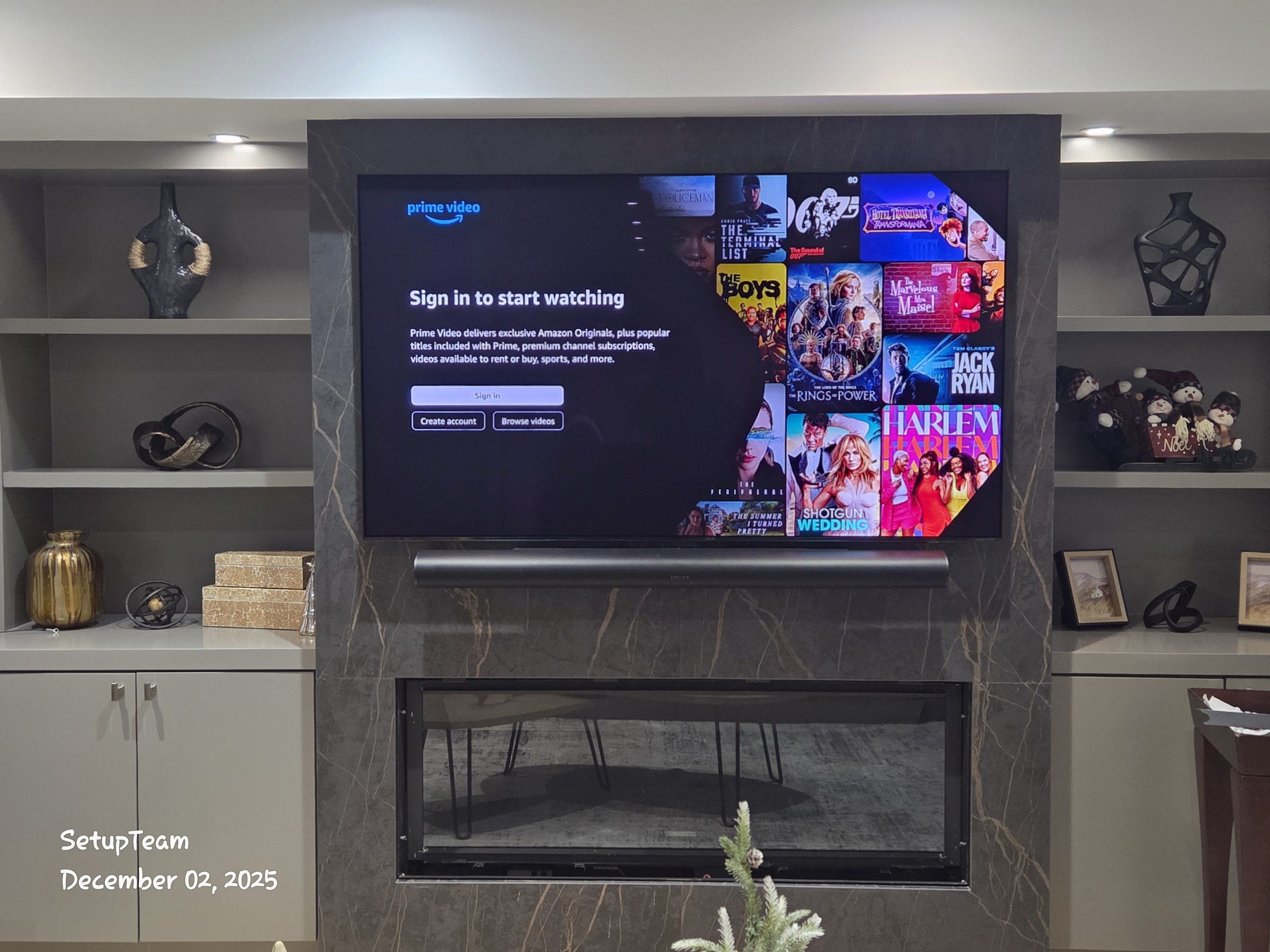
Modern linear gas fireplaces — the long, low units common in newer Newmarket builds and Toronto condo upgrades — typically vent heat forward and slightly upward, with a manufactured surround designed to keep the wall above relatively cool. Many of these units are built specifically with a TV niche in mind. Heat & Glo, Napoleon, and similar manufacturers publish clearance specs that, when followed, leave plenty of room for a TV.
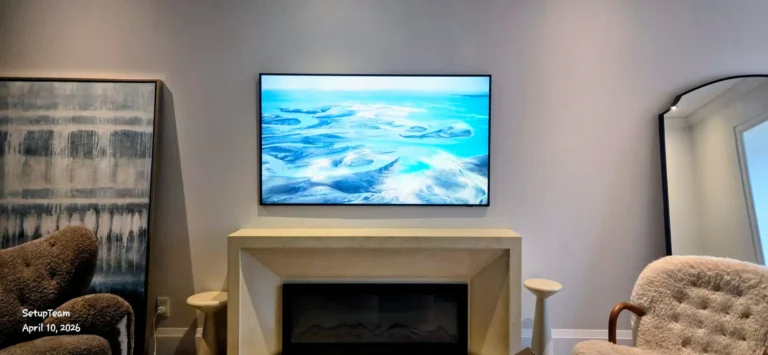
Electric fireplaces are the easiest case. They produce minimal heat at the wall surface, and most can be operated in a flame-only mode that produces almost no thermal load at all. If you want a TV above a fireplace and you have flexibility on the fireplace itself, electric is the path of least resistance.
Wood-burning fireplaces are the hard case. They generate intense, unpredictable heat and they push it directly upward. The wall above an old masonry wood-burner in a Toronto Victorian or a Newmarket century home can get hot enough to damage panel electronics over time, even if the TV survives the first winter. If your fireplace is wood-burning and original to the house, the right answer is usually a pull-down mount or a different wall.
Height: The Mistake Almost Everyone Makes
The optical illusion of a fireplace mantel is brutal. The mantel looks like a natural ledge, and a TV placed just above it looks balanced — until you sit down on the couch. Then you realize you’re tilting your head back at an angle you wouldn’t tolerate in a movie theatre.
The rule of thumb that actually works: the centre of the screen should sit roughly at eye level for a seated viewer, which in most living rooms means somewhere between 42 and 50 inches off the floor. Above a fireplace, the bottom of the screen often ends up at 60 inches or higher. That’s the gap that causes regret.
There are three honest ways around it:
- Choose a smaller mantel or a fireplace without one. Many newer linear gas units in Toronto condos are designed to sit flush with the wall, with no projecting mantel at all. The TV can come down low.
- Use a tilting mount. A 10–15° downward tilt won’t fix bad geometry, but it makes a moderately high TV genuinely watchable.
- Use a pull-down mount. Mounts like the MantelMount allow the TV to drop down in front of the fireplace when in use and retract back up when not. They’re expensive, they’re heavy, and the wall has to be built to take the load — but they solve the problem completely.
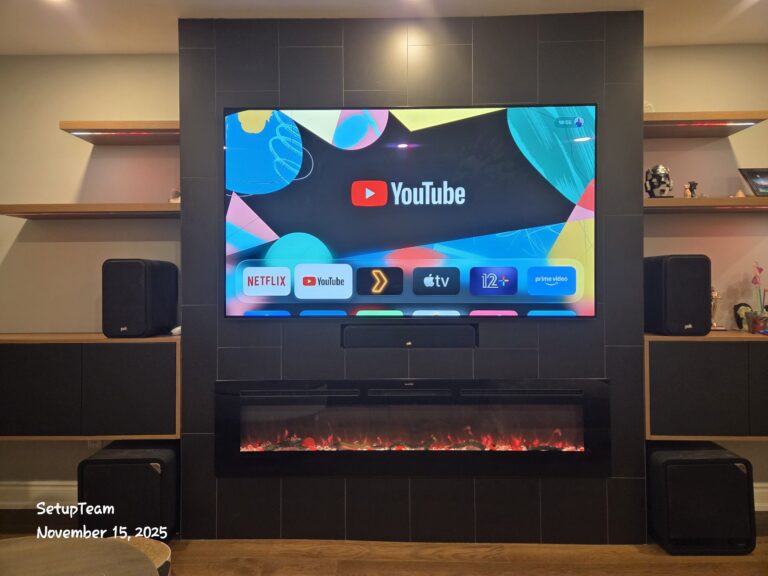
If you’re considering a pull-down mount, it’s worth thinking about the room as a system rather than just the TV. Speaker placement, lighting, and seating distance all interact with viewing height, which is why this conversation often expands into a broader home cinema installation rather than a TV mount in isolation.
What’s Behind the Wall Determines Everything
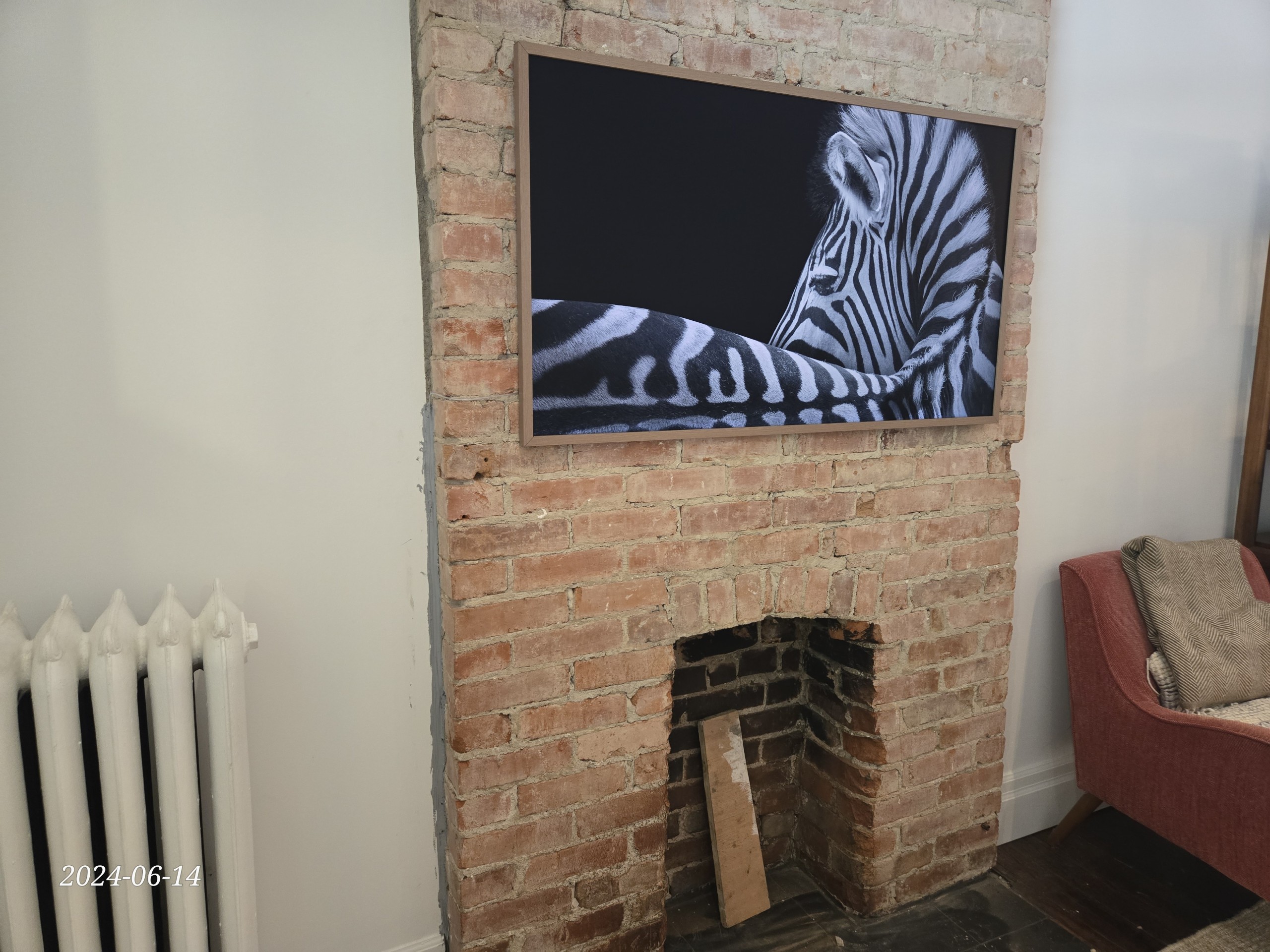
The wall surface above the fireplace is the part of the job that decides how the install actually goes. There are essentially two cases in the GTA: a drywall bump-out built around a manufactured fireplace, or a masonry surround — brick, stone, or stone veneer.
Drywall Bump-Outs vs. Masonry: A Quick Comparison
| Consideration | Drywall Bump-Out | Masonry (Brick or Stone) |
|---|---|---|
| Mounting | Standard lag bolts into framing — fast and clean | Masonry anchors, longer install time, no margin for error |
| Cable concealment | In-wall, fully invisible | Possible but more involved — often run behind the surround or through a discreet conduit |
| Heat exposure | Depends on fireplace, often manageable | Surface stays warmer for longer after fire is out |
| Repair if you change your mind | Drywall patch, paint, done | Visible holes, harder to disguise |
| Common in | Newer Newmarket builds, Toronto condos | Older Toronto homes, Newmarket country properties, custom builds |
On drywall, the install is mostly about finding solid framing and routing cable cleanly. On masonry, the install is about not damaging the surface and making the cable concealment look intentional rather than improvised. Drilling brick or stone veneer requires the right bits, the right anchors, and a willingness to slow down — three things that the budget end of the market tends to skip.
Stone veneer in particular is unforgiving. It looks like real stone but it’s relatively thin, often adhered to a substrate, and it can chip or crack if treated like solid masonry. Anyone mounting on a stone veneer fireplace should know what’s behind the veneer before the first hole goes in.
Cables: The Detail That Separates a Good Job From a Cheap One
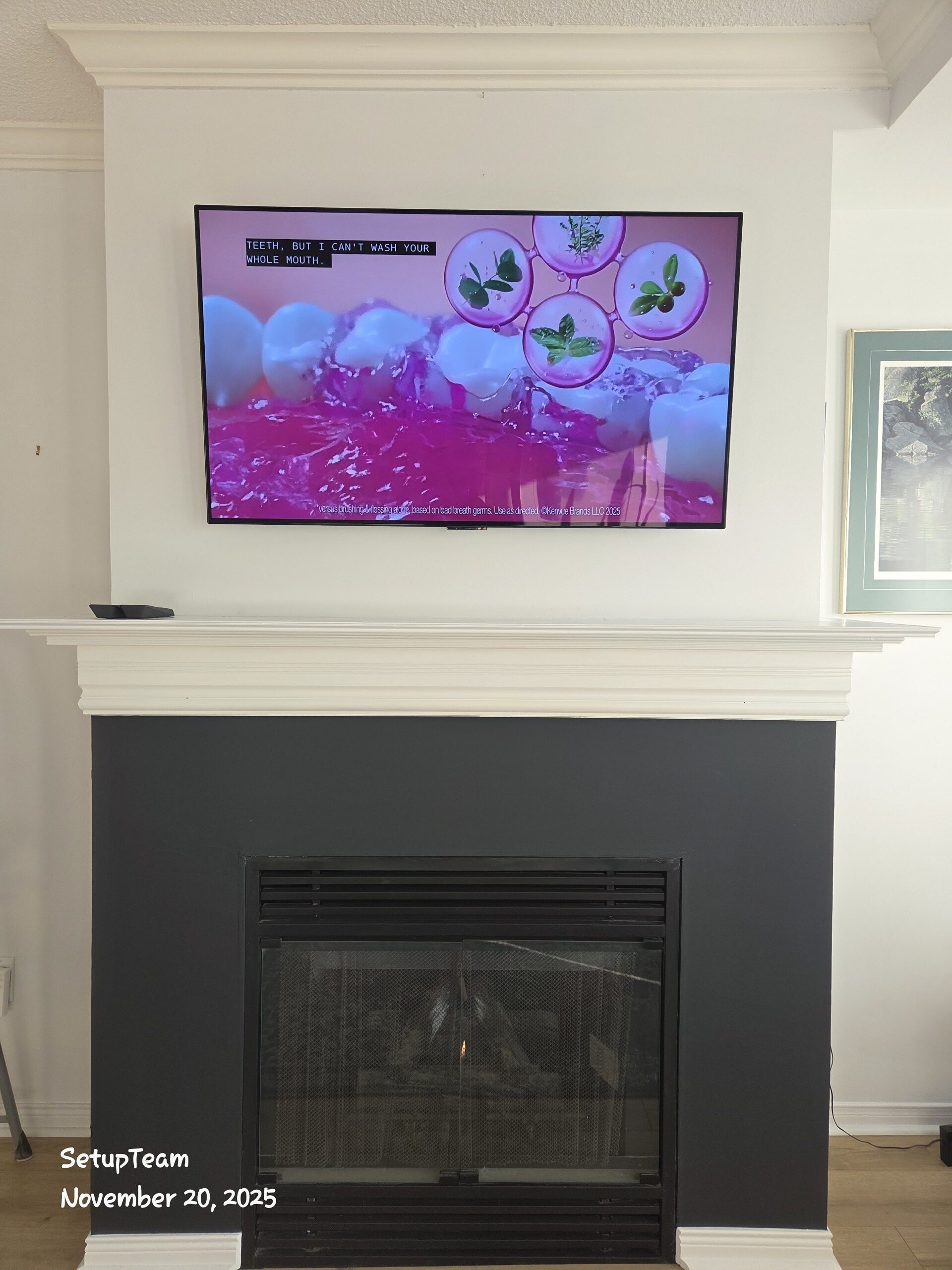
Look at any photo of a TV above a fireplace and the first thing your eye finds is the cables — or the absence of them. A perfectly mounted TV with a black cord dangling down to an outlet at floor level is a tell. It signals that the install was a partial job.
The right approach uses an in-wall power kit: a recessed outlet behind the TV connected through the wall to a second recessed outlet near the fireplace or behind a media cabinet. This is code-compliant because the line voltage stays inside an approved kit rather than running loose romex through the wall cavity. HDMI, optical, and network cables run alongside it through the same channel.
On masonry fireplaces, the cabling story is different. You can’t always punch through brick, and you shouldn’t try unless you know the wall. The cleaner solution on stone or brick is often a paintable surface conduit, sized small and colour-matched, or a routing path that hugs the back of the surround where it isn’t visible from the seating position. Done well, you don’t see it. Done poorly, it’s the first thing every guest notices.
Newmarket Custom Homes vs. Toronto Condos
The two ends of our market have different problems and different solutions, and pretending they’re the same job leads to bad outcomes in both directions.
Newmarket and the surrounding area — Aurora, King City, the rural townships — lean toward custom builds and larger family homes with stone or brick fireplaces, often two-storey great rooms, and frequently with the fireplace as the architectural centrepiece of the main living space. The challenge here is usually scale: the room is big, the fireplace is tall, and there’s a strong temptation to mount a TV at a height that suits the wall but punishes the viewer. The right answer in these rooms is often a smaller TV than homeowners initially imagine, mounted lower than they expect, with a pull-down option if the mantel can’t be avoided. We do a lot of TV wall mounting in Newmarket where the conversation starts with “as high as possible” and ends with the TV three feet lower than the original plan — and the homeowner happier for it.
Toronto condos are the opposite problem. The fireplace, if it exists, is usually an electric or sealed gas unit built into a drywall bump-out. Heat is rarely the issue. Space is. The wall is short, the room is narrow, and there’s often a structural column or HVAC chase nearby that limits where cables can run. Cable concealment in a concrete-walled condo can require a different routing strategy entirely, since you can’t fish wire through a poured wall the way you can through framing. TV wall mounting across Toronto in older buildings — anything pre-2000 with concrete demising walls — tends to require a workaround that homeowners rarely anticipate.
When a TV Above the Fireplace Is the Wrong Answer
Sometimes the honest recommendation is don’t. If the fireplace is a high-output wood-burner, if the mantel sits eight feet off the floor, if the seating is closer than ten feet to the wall, if the room has a better wall available — any one of these is a reason to rethink. Resale arguments cut both ways too. A well-executed TV above a fireplace adds polish to a room. A clearly compromised one looks like a homeowner’s mistake to every buyer who walks through.
Most installs above fireplaces work out beautifully because the homeowner thought the decision through before committing. The ones that don’t are almost always the ones where someone said “just mount it up there” without asking what’s behind the wall, how hot it gets, and how it’ll feel to watch a two-hour film from the couch.
If the goal is a setup that still works five years from now — TV intact, cables hidden, the room as good-looking as it was on day one — the install is only part of the picture. An ongoing technology support plan matters more than people realize, particularly for systems that mix a TV, a soundbar, smart controls, and a fireplace that all need to coexist on the same wall.