

TV Speakers vs Soundbars vs Home Theater Systems
Home Audio Guide
TV Speakers vs. Soundbars vs. Surround Sound: Which Upgrade Is Right for Your Room?
A soundbar is better than TV speakers for every home. Surround sound is better than a soundbar for rooms where physical speaker placement is possible. Those two sentences answer most of what homeowners are actually trying to decide. The rest of this guide fills in the specifics — what changes at each tier, which products deliver it, what it costs in the GTA, and how to decide which upgrade fits your room and your renovation timeline.
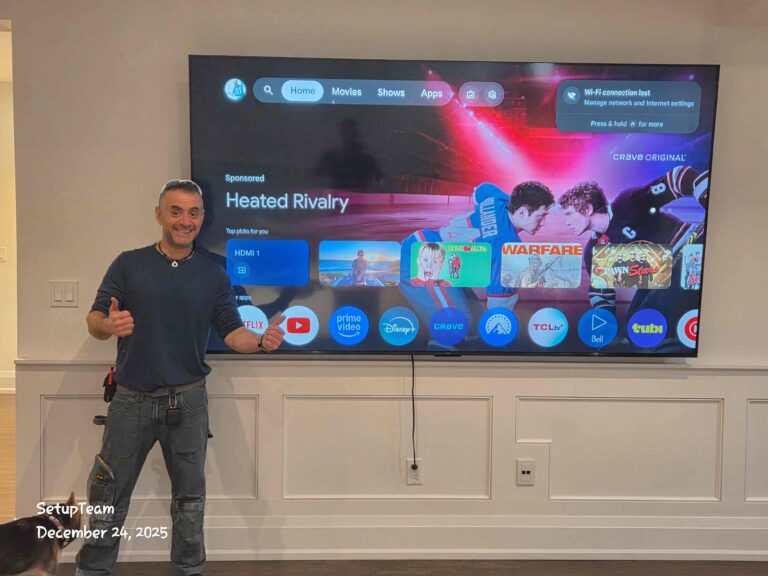
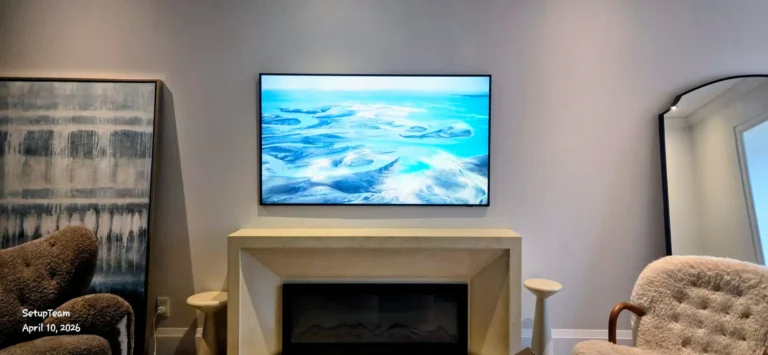
This question comes up constantly after TV wall mounting. The screen looks exactly as it should. The audio is a different story — and in many cases, the mount makes it worse. Understanding what separates built-in speakers from a soundbar from a full surround system stops the gap from being a surprise and makes the upgrade decision straightforward.
Quick Answers
Is a soundbar actually better than built-in TV speakers?
Yes — significantly and immediately. TV speakers roll off below 150Hz and typically fire rearward or downward. Even a Sonos Beam ($599 CAD) uses forward-facing drivers tuned for dialogue clarity and stereo width. The difference in speech intelligibility is noticeable from the first sentence of any programme.
Does Dolby Atmos work on a soundbar?
In rooms with 8–9 foot flat ceilings and symmetrical walls, yes. Soundbar Atmos bounces sound off the ceiling using upward-firing drivers. In open-concept GTA homes with vaulted ceilings, large kitchen openings, or L-shaped layouts, the reflections become unpredictable and the height effect breaks down.
What is the real difference between a soundbar and surround sound?
A soundbar produces all audio from one point directly in front of you. A 5.1 surround system puts discrete speakers at physically different positions in the room. The brain localises sound using microsecond arrival-time differences between the ears — a single source cannot simulate that, regardless of processing.
Should I get wireless Sonos surround or a wired system?
Wireless Sonos (Arc Ultra + Sub + Era 300 rears, from approximately $3,800 CAD in hardware) is the right choice for finished homes. Wired surround is the right choice during new construction or active renovation, when speaker cable can be run inside walls. The decision is almost entirely about where you are in the renovation cycle.
Why does my TV sound worse after wall mounting?
Most TVs have downward- or rear-firing speakers that bounce sound off the TV stand surface toward the listener. Wall mounting removes that reflective surface — sound fires directly into the wall. A soundbar with forward-facing drivers resolves this immediately, independent of the TV’s mounting position.
Why Built-In TV Speakers Disappoint — and Why It’s Not the TV’s Fault
Contemporary televisions are engineered almost entirely around thinness. A panel under 25mm deep leaves almost no internal volume for speaker enclosures. Manufacturers are working with very small drivers — often generating 20 to 40 watts total — housed inside a chassis that cannot move enough air to fill a living room. The frequency response rolls off sharply below 120–150Hz. That’s exactly where male voices, film score low-end, and the weight of nearly every musical instrument live.
OLED televisions, among the most visually impressive panels available, are often the worst offenders for audio. The engineering that produces the extraordinary picture quality — extremely thin panel construction — directly limits speaker enclosure volume and driver size. The same choices that give you perfect blacks give you thin, compressed sound.
The Dialogue Problem
The most common complaint is specific: “We can’t understand what anyone is saying.” Not “the sound isn’t great” — specifically dialogue. Turning volume up doesn’t resolve it. A louder version of the same compromised frequency response is just louder; the clarity problem traces to bandwidth, not amplitude. The consonant sounds that make speech parse clearly — the edges of words — sit in a frequency range that small drivers in tight enclosures struggle to reproduce without compression and distortion. This is why a Sonos Beam at conversation-level volume sounds clearer than a built-in TV at near-maximum.
Soundbars vs. TV Speakers: What Actually Changes
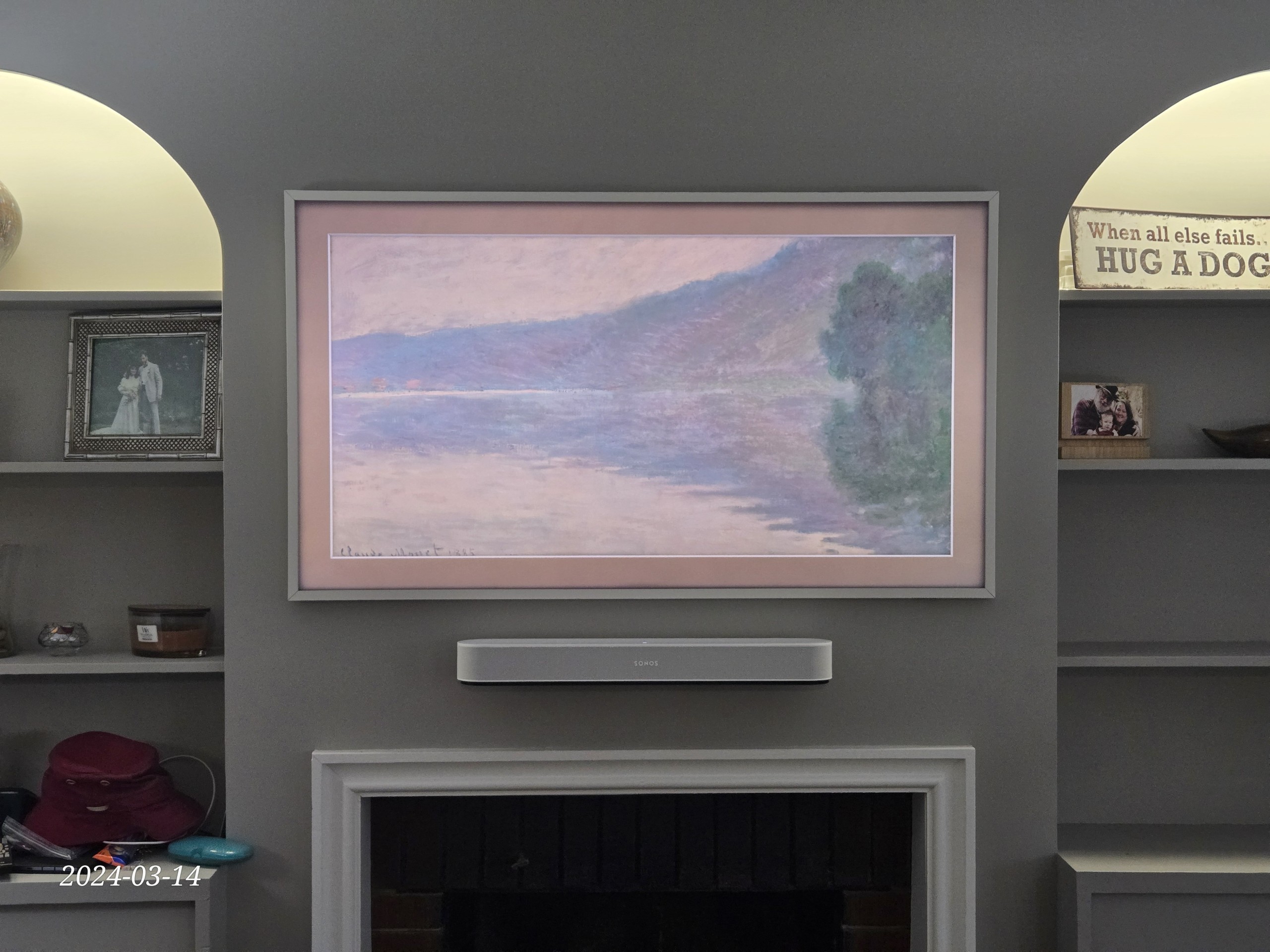
A quality soundbar replaces small, rear-facing TV drivers with larger, forward-facing ones specifically tuned for dialogue intelligibility and full mid-range presence. The improvement is immediate and categorical — not subtle. The Sonos Beam ($599 CAD) handles rooms up to roughly 350 square feet and delivers noticeably cleaner speech than virtually any built-in TV speaker. Step up to the Sonos Arc Ultra ($1,099 CAD) and you add 11 drivers, four upward-firing channels for Atmos, and enough output to fill rooms in the 500–700 square foot range convincingly.
One effect that tends to surprise people: a good soundbar allows comfortable listening at lower volumes. The gain in clarity means you’re no longer straining to follow conversation — a quality-of-life shift that matters considerably for evening viewing or households sensitive to sound levels.
Add a Subwoofer: Where the Improvement Gets Physical
Pair a soundbar with a Sonos Sub ($899 CAD) or Sonos Sub Mini ($599 CAD) and the improvement moves from a hearing experience to a physical one. Bass stops being suggested and starts being felt. A quality soundbar-and-sub combination typically covers 35Hz to 20kHz — compared to the 150Hz to 15kHz that built-in TV speakers manage at best. The Sonos Sub handles frequencies down to around 25Hz in practice, which is where film sound design lives: the low-end rumble of a helicopter, the foundation of a film score, the physical register of an explosion. That extension changes the character of nearly every type of content.
The One Thing a Soundbar Cannot Do
A soundbar has one structural constraint that no engineering can overcome: every driver fires from the same point in the room. The brain is extraordinarily good at three-dimensional sound localisation — it does this automatically, using arrival-time differences measured in microseconds between the two ears. No processing creates a convincing sensation of sound arriving from behind you when the source is directly in front of you. Virtual surround is a simulation that works at low to moderate volumes in ideal listening conditions. It breaks down at higher volumes, in rooms with complex geometry, and in any listening scenario that involves off-axis seating.
Does Dolby Atmos in a Soundbar Actually Work?
Premium soundbars — the Sonos Arc Ultra, Sony Bravia Theatre Bar 9, Samsung HW-Q990D — advertise Dolby Atmos. The honest answer is: it depends on the room, and most GTA homes are not the ideal environment.
Soundbar Atmos uses upward-firing drivers to bounce sound off the ceiling, combined with DSP processing to extend the perceived soundstage above the listener. In rooms with 8–9 foot flat ceilings, symmetrical walls, and a listening position centred in the space, this works genuinely well. Rain, helicopter sweeps, concert hall reverb — these can arrive with convincing spatial accuracy.
Most contemporary GTA homes are open-plan. Kitchen flowing into dining into living room. Ceilings at ten or twelve feet in newer builds, cathedral ceilings in some Vaughan and Richmond Hill custom homes, soffits and pot light clusters that interrupt clean reflection paths. These are not the environments where bounced Atmos height channels perform as marketed. Virtual surround requires the room to cooperate acoustically. A large percentage of GTA living rooms don’t.
This is not a reason to dismiss soundbar Atmos — in the right room, a Sonos Arc Ultra is genuinely impressive. It’s a reason to evaluate your specific ceiling height and room geometry honestly before assuming the marketing claim will translate to your space.
Surround Sound vs. Soundbar: What Real 5.1 Adds
A proper surround system abandons simulation and puts discrete drivers where the sound actually needs to originate. Front left and right speakers deliver the stereo soundstage. A dedicated center channel — positioned directly below or above the screen — handles dialogue, which is why speech intelligibility in a well-configured 5.1 system is categorically better than any soundbar, including the best Sonos Arc configuration. Surround speakers at or behind the listening position deliver ambient and directional effects as physical events rather than processed impressions.
The result is dimensionality. Not simply more volume or fuller bass, but a spatial quality to the listening experience. A car passing on screen registers behind you in the room before it exits frame. A stadium broadcast becomes a location. This isn’t the brain being convinced through DSP — it’s experiencing real arrival-time differences from real speakers at real positions. No virtual processing replicates that, because the physics of human spatial hearing requires the source to actually exist in the right position.
A Real Installation: Vaughan Living Room, Sonos Arc Ultra System
In a Vaughan home last year, a customer came to us after struggling with a Sonos Arc installed in a previous house that had performed exceptionally. The new home was a large open-concept great room — approximately 650 square feet, twelve-foot ceilings, kitchen running directly off the living area with no separating wall. The Arc’s Atmos height channels were essentially non-functional in the space: no consistent ceiling to reflect from, and the room was simply too large for the soundbar’s output to fill convincingly at normal listening volumes.
The solution was a wireless 5.1 configuration: Sonos Arc Ultra as the primary soundbar, Sonos Sub for low-end extension, and two Era 300 rear channels positioned at the seating position flanks. The Era 300 units contribute actual side and height channel audio through their own upward- and side-firing drivers — not ceiling reflections, physical speaker positions. Total hardware cost was approximately $4,200 CAD; installation including Trueplay calibration, eARC configuration, and network verification was completed in just under four hours. The difference from the Arc-alone configuration was not incremental. Dialogue anchored to the screen, the rear channels created genuine spatial separation, and the Sub filled a room that a soundbar-only setup couldn’t reach. The customer had been ready to write off wireless surround entirely based on the previous experience — the issue was room geometry, not the technology.
Wireless Sonos Surround vs. Wired: Which Path Makes Sense
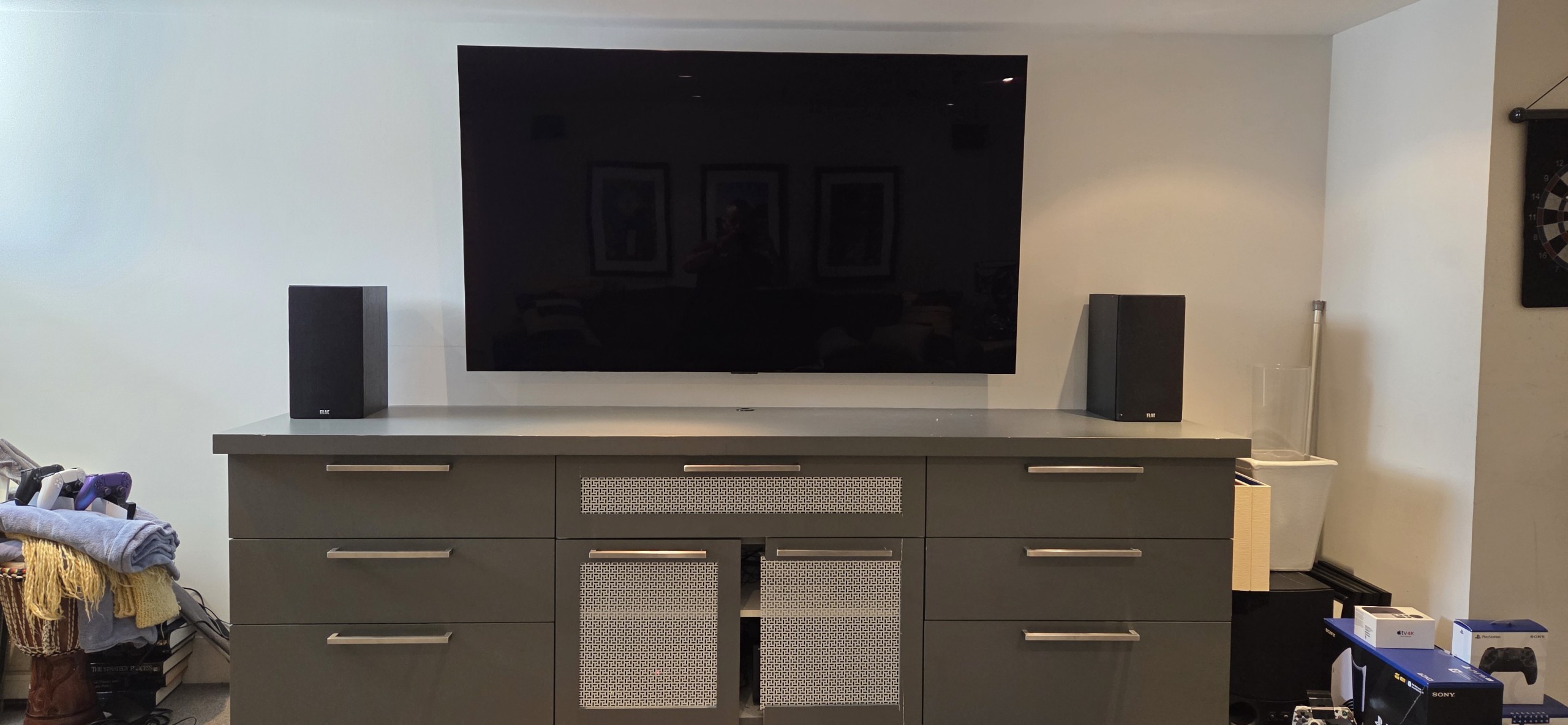
Most homeowners arrive at one of two approaches. The right choice is almost entirely determined by where you are in the renovation cycle — not which system performs better in absolute terms.
Wireless Sonos: Best for Finished Homes
Wireless surround exists to solve one specific problem: upgrading a finished home without opening walls. A Sonos 5.1 configuration — Arc Ultra as the soundbar, Sub, and two Era 300 rear channels — requires only power at each speaker location. No speaker cable routing, no drywall, no construction disruption.
Professional Sonos installation includes Trueplay room calibration using an iPhone’s microphone to adjust each driver’s frequency output for the specific space, eARC configuration for lossless Dolby Atmos passthrough, and full multi-room grouping setup. These are the steps that determine whether a Sonos system actually performs as intended — Trueplay in particular produces noticeably better results when the calibration walk is done methodically across the full listening area. A typical wireless Sonos 5.1 install runs two to four hours start to finish.
This path also integrates cleanly with whole-home audio. The living room system and the multi-room music system are the same system — one app, one ecosystem, Sonos Era speakers in the kitchen, Amp-driven in-ceiling speakers in the primary bedroom, a Move on the patio. For GTA homeowners who want both theatre performance and whole-home music, this integration is a core advantage that a traditional wired theatre doesn’t offer without a significant additional control system investment.
Wired Surround: Best During Construction or Renovation
Wired surround routes dedicated 14 or 16-gauge speaker cable inside walls and ceilings before drywall closes. Once infrastructure is in place, the system carries no Wi-Fi dependency, supports maximum amplification headroom, and accommodates any speaker brand and configuration without replacing existing infrastructure.
A full wired build for a dedicated home cinema installation — front left, centre, and right speakers, four in-ceiling Dolby Atmos height channels, side and rear surrounds, and a subwoofer — delivers a listening experience that no wireless system currently matches at equivalent price points. In-ceiling Atmos height speakers produce genuine overhead audio: the sound comes from above because the driver is literally above the listener. Wired systems also support hardware upgrades without replacing the system infrastructure — swap an AV receiver for a newer Denon or Marantz model and the speakers remain exactly as installed.
The trade-off is timing. Retrofitting speaker cable through a finished Ontario home — particularly through the fire-rated assemblies in newer construction — is significantly more labour-intensive than installing during the rough-in phase. The opportunity cost of waiting for a renovation to run conduit is almost always worth taking.
The Network Factor Soundbar Reviews Never Mention
Consumer soundbar reviews almost never discuss home network requirements. Professional installers do — because it’s the most common cause of wireless surround problems after installation.
Sonos depends entirely on the home network for speaker synchronisation and audio delivery. Any dropout, latency spike, or subnet conflict creates audible glitches, delayed rear channels, or complete audio loss. This isn’t a Sonos hardware problem: it’s a network infrastructure problem. In larger GTA homes — properties with mesh systems misconfigured in double-NAT, or rooms where Wi-Fi coverage drops near Era 300 locations — the wireless surround experience degrades in ways that look like equipment failures but trace directly to the router.
This is why Wi-Fi and network optimization is sometimes a prerequisite for a wireless audio project. A properly configured network — single DHCP assignment, adequate signal at each speaker location, no double-NAT from an ISP gateway stacked behind a second router (a common configuration with Bell Fibe and Rogers Ignite home setups) — is the foundation wireless audio depends on. Without it, the best soundbar in the world will underperform.
Which Tier Is Right for Your Room? A Decision Guide
The honest answer depends on three things: how you use the space, where you are in the renovation cycle, and what your room’s acoustics will actually support.
| Tier | Best For | Approx. Cost (CAD, hardware + installation) | Limitation |
|---|---|---|---|
| Built-in TV speakers | Temporary setup only | $0 | Dialogue clarity, no bass, rear-firing in wall-mount scenarios |
| Soundbar (e.g. Sonos Beam + Sub Mini) | Condos, apartments, bedrooms, smaller living rooms | $1,200–$1,800 | All audio from one point; virtual surround only |
| Soundbar + Sub (e.g. Sonos Arc Ultra + Sub) | Most GTA living rooms in finished homes | $2,200–$3,200 | Atmos is room-dependent; no physical rear channels |
| Wireless 5.1 (e.g. Arc Ultra + Sub + Era 300 rears) | Finished homes wanting physical surround without construction | $4,000–$5,500 | Requires solid home network; no in-ceiling Atmos |
| Wired surround / dedicated cinema | New construction, renovation, dedicated media rooms | $8,000–$25,000+ | Construction-phase decision; highest cost and complexity |
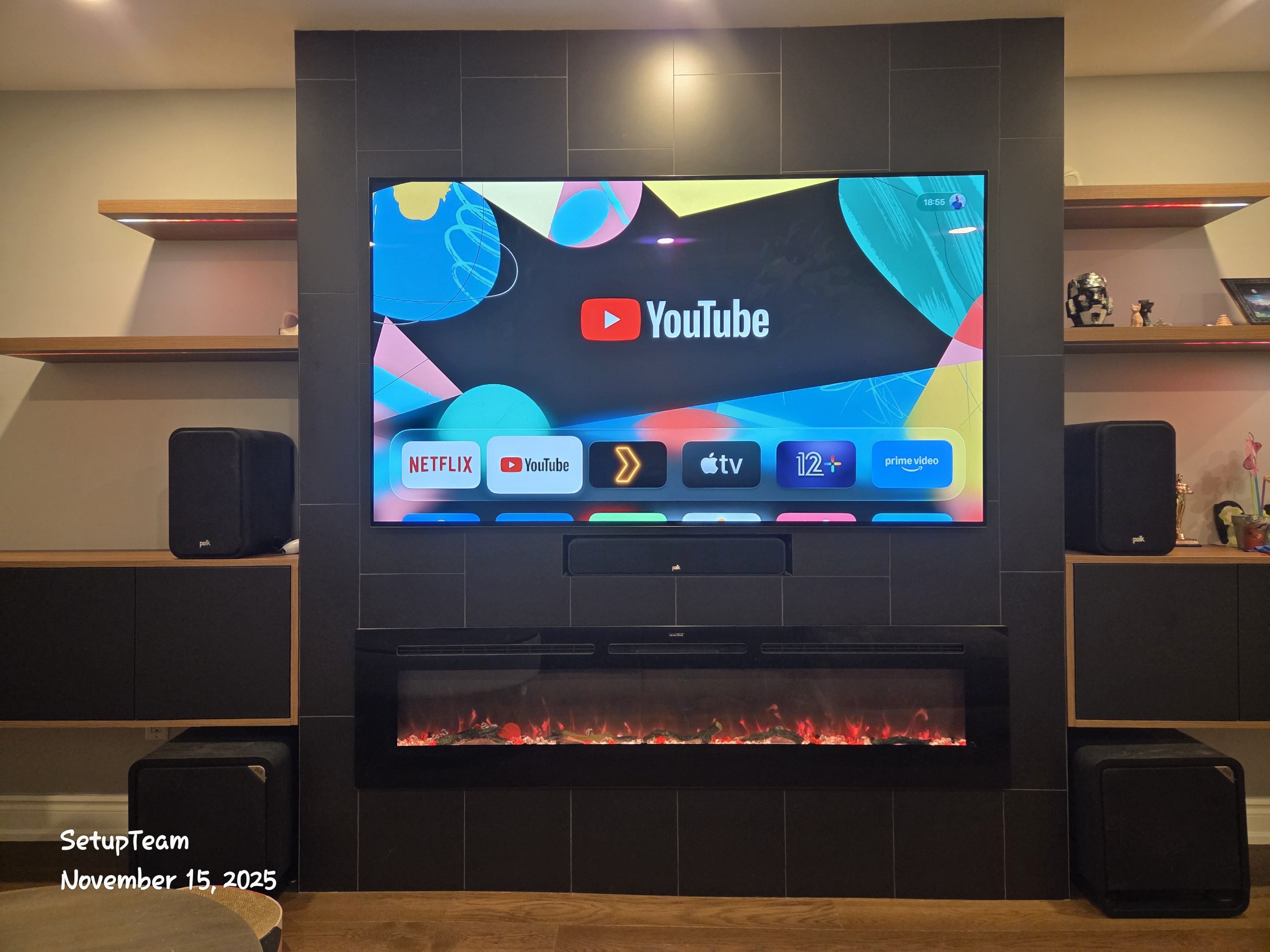
A soundbar with a subwoofer is the right choice for most condos, apartments, and living rooms in finished GTA homes where the priority is immediate improvement in dialogue clarity and bass without construction. It solves the most common complaints and represents the best return on investment and effort for the majority of homeowners in this region.
Wireless 5.1 — a Sonos Arc or Arc Ultra with Sub and rear channels — is the right choice when spatial audio matters and running cable isn’t an option. The difference from a soundbar-only setup is qualitative, not incremental. The Vaughan installation above is a representative example of what this tier delivers and what it requires.
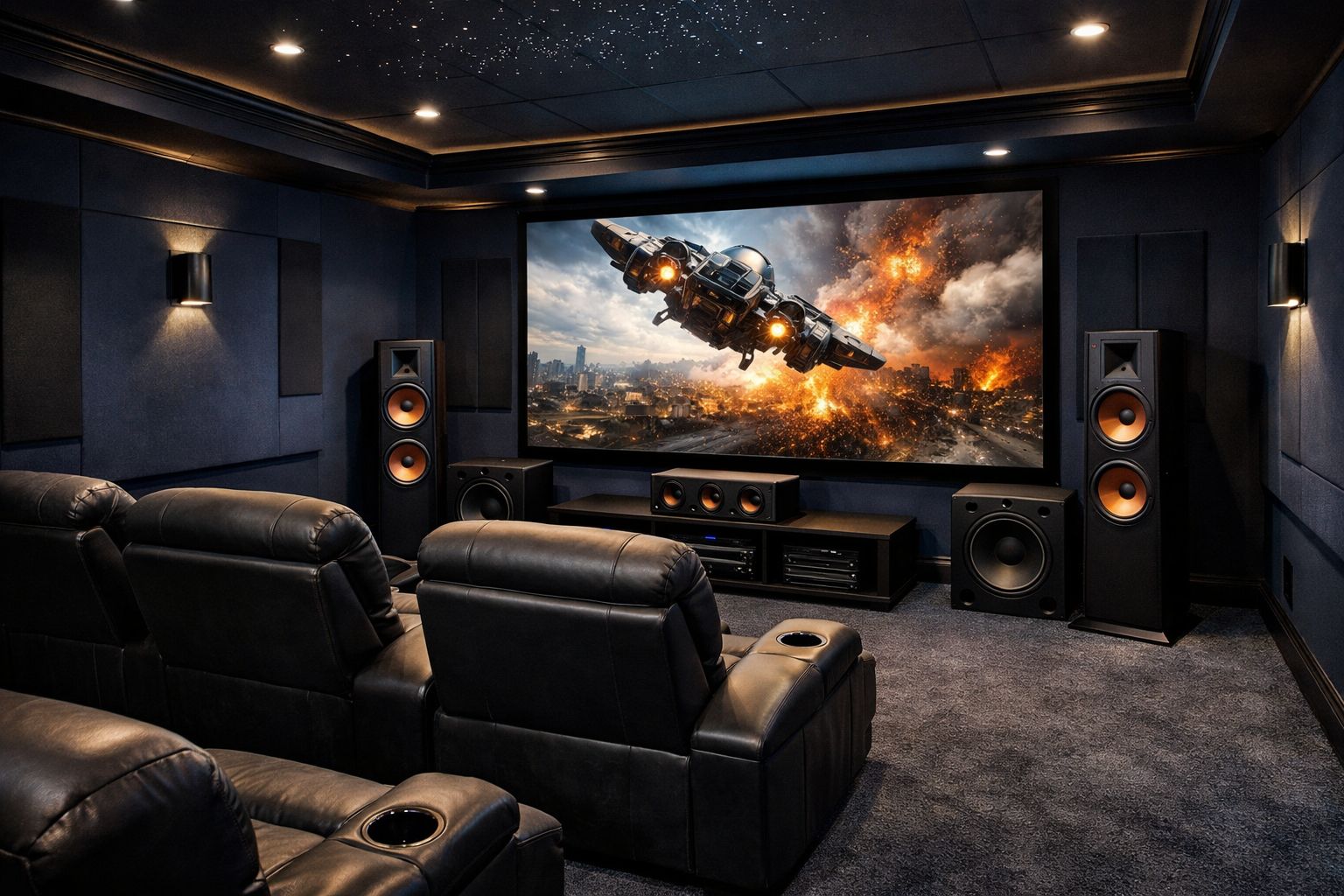
Wired surround, in-ceiling Atmos, or a full dedicated cinema room is the right choice during new construction or active renovation. This is the path to the highest-performance outcome — the kind of room where the audio matches or exceeds a commercial cinema. It requires the walls to be open. If they are, it’s worth doing correctly.
Frequently Asked Questions
Is a soundbar worth buying if I already have a decent TV?
Yes, for virtually any television. Modern TVs prioritise thinness, which directly limits speaker enclosure volume and driver size. A quality soundbar — particularly one paired with a wireless subwoofer — delivers a categorical improvement in dialogue clarity, bass response, and overall listening comfort. The Sonos Beam at $599 CAD and the Sonos Arc Ultra at $1,099 CAD represent two meaningful points on that range, with the right choice depending on room size and how much bass extension matters.
What is eARC and why does it matter for my soundbar?
eARC (Enhanced Audio Return Channel) is a feature on HDMI 2.1 ports that allows a television to send full-resolution, lossless audio to a connected soundbar — including Dolby Atmos and DTS:X. Without eARC, the TV can only pass compressed audio formats, which limits the quality ceiling of the soundbar’s Atmos processing. On most current televisions, the eARC port is labelled and is typically HDMI 2 or 3. Connecting the Sonos Arc or Arc Ultra to any other port delivers noticeably reduced audio quality.
How does Sonos Trueplay calibration work and does it make a difference?
Trueplay is Sonos’s room calibration process, performed using the microphone in an iPhone or iPad. The app plays test tones through each speaker and captures how they interact with the room’s surfaces — walls, floors, furniture, ceilings. It then adjusts each driver’s frequency output to compensate for the room’s acoustic response. It makes a noticeable difference in rooms with hard surfaces or asymmetric layouts. Professional installation produces better Trueplay results than self-setup because the calibration walk is performed methodically across the full listening area rather than from a single position.
Can I add surround sound to a TV that’s already wall mounted?
Yes. Most surround upgrades happen after the TV is already installed. Wireless systems like Sonos are specifically designed for this — the Arc mounts below the TV, the Sub and Era 300 rear speakers require only power outlets, and no existing installation needs to be disturbed. Wired retrofits are also possible but require in-wall cable routing through finished walls, which is significantly more labour-intensive. A wireless approach is usually the practical choice in any completed GTA home.
Does speaker placement really matter that much?
It matters more than most people expect. Subwoofer placement affects bass frequency response dramatically due to room modes — the same subwoofer can sound boomy or thin depending purely on where it sits relative to the room boundaries. Surround speakers at the wrong height or angle reduce or eliminate the spatial effect. Center channel alignment affects how closely voices stay anchored to the screen. Professional installation evaluates seating position, room dimensions, furniture layout, and acoustic reflection points before placing anything — because placement errors make excellent equipment perform like average equipment.
Is Sonos Arc good enough for a large living room?
The Arc Ultra performs well in rooms up to approximately 500–600 square feet with standard ceiling heights. In larger open-plan spaces — particularly the great room layouts common in Vaughan, Richmond Hill, and Oakville new construction, where ceilings reach 10–14 feet and rooms exceed 700 square feet — the Arc may not fill the space convincingly without a Sub, and the Atmos height effects become unreliable as ceiling geometry makes reflections unpredictable. For those rooms, a wireless 5.1 configuration with dedicated Era 300 rear channels, or a wired system with in-ceiling Atmos speakers, will outperform a soundbar-only setup.
What is the Sonos Era 300 and how does it fit into a surround system?
The Sonos Era 300 ($599 CAD each) is Sonos’s dedicated spatial audio speaker, designed to function as a surround channel in a home theatre configuration or as a standalone Dolby Atmos music speaker. It includes side-firing and upward-firing drivers, which means when used as a rear surround paired with an Arc, it contributes actual height and side-channel audio through its own drivers — not ceiling reflections from the soundbar. For living rooms where Atmos performance from the soundbar alone is limited by ceiling height or room shape, adding a pair of Era 300 rear channels meaningfully extends the spatial envelope.
How much does a professional soundbar installation cost in Toronto?
Professional soundbar installation — including wall mounting below a mounted TV, cable concealment, and HDMI eARC configuration — typically runs between $150 and $350 CAD depending on wall construction and cable routing complexity. The soundbar hardware ranges from approximately $350 for a Sonos Ray to over $1,100 for a Sonos Arc Ultra. A complete Sonos Arc Ultra plus Sub installation from SetupTeam, including hardware and installation, generally falls between $2,200 and $3,200 CAD depending on wall type and mounting complexity.
How long does a Sonos surround installation take?
A wireless Sonos 5.1 setup — Arc Ultra, Sub, and two Era 300 rear channels — typically takes two to four hours including mounting, cable management, eARC configuration, Trueplay calibration, and multi-room grouping setup. A fully wired 5.1 or 7.1 system in an existing home takes longer, depending on cable routing complexity, AV receiver configuration, and whether drywall work is required. New construction wired theatre builds are scoped individually.
Can Sonos be used as a whole-home audio system, not just for TV?
Yes, and this is one of Sonos’s most significant practical advantages. A Sonos Arc in the living room can be grouped with Era 100 or Era 300 speakers in the kitchen, Amps driving in-ceiling speakers in the primary bedroom or covered patio, and a Move or Roam portable speaker elsewhere — all controlled through one app, all playing synchronised audio. The home theatre system and the whole-home music system are the same system. This integration is a core reason Sonos is the dominant wireless audio choice for GTA homeowners who want both theatre performance and multi-room music without two separate ecosystems.
What is the difference between 5.1, 7.1, and Dolby Atmos (e.g. 5.1.4)?
The first number indicates front speakers (left, centre, right). The second number is the subwoofer count. The third number — present in Atmos configurations — is the height channel count. A 5.1 system has five speakers and one subwoofer: the standard for home surround sound. A 7.1 adds two additional side or rear surround channels. A 5.1.4 adds four overhead speakers (in-ceiling or upward-firing) for full Dolby Atmos height. Each step increases spatial accuracy, with diminishing returns for casual viewing and increasing returns for a dedicated listening room.
What AV receiver brands does SetupTeam specify for wired surround systems?
SetupTeam works with Denon, Marantz, and Yamaha for residential wired theatre builds. The Denon AVR-X series suits mid-range builds well; Marantz is the preference for higher-end applications where output accuracy, multi-channel stability, and long-term reliability are priorities. Yamaha’s AVENTAGE line is also a strong choice for custom builds with specific power requirements. Specification is always based on the actual installation — room size, speaker impedance, channel count, and usage pattern — rather than brand preference.