

Network Installation Across Every Floor in Richmond Hill
Getting cable from a basement rack to a third-floor office in a house that is already finished is a routing problem before it is a network problem. We find the riser, fish Cat6 or Cat6A up it, and land wired access points, workstation drops, and camera runs on every storey.
How does cable get from a basement rack to the third floor?
Through a riser. A stacked closet, the chase beside a plumbing stack, the void behind a bulkhead, or a boxed corner running the full height of the house will each carry cable between storeys. Finding one usable vertical path is most of the work, and in a finished house it is the part that decides whether the rest is a morning or a week. Once cable is up that path, every storey is reachable, which is what makes Wi-Fi optimization in Richmond Hill worth paying for instead of another mesh node in the hallway.
Finding the Riser Before Cutting Anything
Stacked closets on each level, the bulkhead over a stairwell, and the cavity beside a plumbing stack are the three routes that work most often in these houses. We check each one with a rod and a scope, confirm it runs clear top to bottom, then commit to the drop plan.
One Wired Access Point per Storey
A ceiling drop on each level beats a repeater on each level. Wireless backhaul sheds throughput on every hop, and a double-joisted or poured floor makes the hop worse. Each access point runs on its own cable back to the switch, so the top floor performs like the main floor.
The Office Two Floors Above the Router
This is the call we take most often here. A wired drop at the desk plus an access point in that same ceiling ends the dropped video calls for good, and it usually comes off one riser pull with a horizontal leg along a single joist bay.
Reaching a Top Floor With No Attic
Where the top storey has a finished ceiling and no accessible attic above it, the run comes up the riser and out through a closet on that level instead. The plate lands in the closet wall and the cable turns into the room behind the baseboard.
Fibre already at the door: a gigabit connection ends wherever the wiring ends. If the second and third storeys are living on wireless hops, the speed you pay for stops at the modem and the number on your bill describes the driveway rather than the house. Copper up the riser and a wired access point on each level is what moves that figure to the far end of the top floor.
What can be added to a Richmond Hill home once the drywall is up?
More than most owners expect. Data drops, ceiling access points, TV runs, speaker cable, camera and doorbell wiring, and shade pre-wire all fish into a closed house. What changes is the labour per drop, not whether the drop is possible.
Cat6 and Cat6A Fished to the Room
Home runs pulled through existing cavities to a keystone plate in a room that never had one. Cat6A only where the riser leg plus the horizontal leg pushes a run past about 180 feet, or where a run goes underground or out to an outbuilding.
Ceiling Access Point Drops
A hole cut in the finished ceiling, cable fished to it from the riser, the access point mounted flush and the opening hidden behind its own bracket. Wired backhaul on every storey, no repeating between levels.
Rack and Panel in an Existing Room
Built where the internet service already enters, sized to the equipment list rather than to a catalogue photo, and labelled port by port so the next change takes minutes instead of an afternoon of tracing.
Runs to Displays Already on the Wall
Cat6 pulled up behind a television that is already mounted, for extenders and streaming hardware. Fished from below where the basement ceiling is open, and from the riser where it is not.
Speaker Wire Into Finished Ceilings
16/2 and 14/2 fished into rooms with the ceiling already closed, cut in at the speaker opening and run back to one amplifier location. Works with Sonos installation in Richmond Hill or any distributed amplifier.
Camera and Doorbell Cable After the Fact
PoE runs out through a rim joist or a soffit to exterior camera positions, back to the recorder at the rack. Penetrations sealed, cable sleeved where it leaves the building. UniFi Protect, Hikvision, or anything else wires the same.
Shade and Keypad Runs in Closed Walls
Low-voltage cable fished to shade headers and keypad boxes for Control4 installation in Richmond Hill, Lutron, or any motorized shade. Positions get agreed first, because a keypad box in a finished wall does not move.
Pulls Booked Around a Renovation
When a contractor has a ceiling or a wall open on any level, we book that window and drop cable into it. Half an hour in an open ceiling replaces two hours of fishing once it closes.
PoE Switching for the Device Count
Managed switching sized to the wattage the access points, cameras, and doorbell draw, with headroom left over so the next device you add does not push the power budget past its limit.
Should you wait for a renovation before adding drops upstairs?
No, but take the window if a renovation gives you one. A ceiling already open on the second storey is the cheapest hour we will ever spend in your house, so we book that day and drop cable into the opening while it lasts. Everything else gets fished afterwards. One boundary: a house being built from scratch, or a framing-stage addition, is a different job with a different plan, and it belongs on our new construction pre-wiring page rather than on this one.
- We read the trade schedule and pull between the electrician and the drywaller
- Same-week callout when a ceiling opens sooner than the site expected
- Drop positions checked against the millwork drawings, not after them
- One invoice for the low-voltage package, so nobody chases three trades
- Return after paint for termination, rack build, testing, and the port map
Where does the rack go, and how much switch do three storeys need?
At the foot of the riser, on the wall nearest where the internet service enters, and sized to the real device count. A house carrying an access point per storey, exterior cameras, a doorbell, and a home office moves more traffic than an unmanaged eight-port switch handles without complaint. Splitting that traffic is where Richmond Hill Wi-Fi optimization usually starts.
- Managed PoE switching sized to the wattage each device draws
- Separate VLANs for automation, work devices, and guest traffic
- Patch panel labelled to the room, with a port map you keep
- Cable management that survives the next three devices you add
- Ready for Control4 automation in Richmond Hill and Sonos hardware
- Rack depth and height matched to the equipment, not to appearances


Three storeys, one riser, and no wire on show
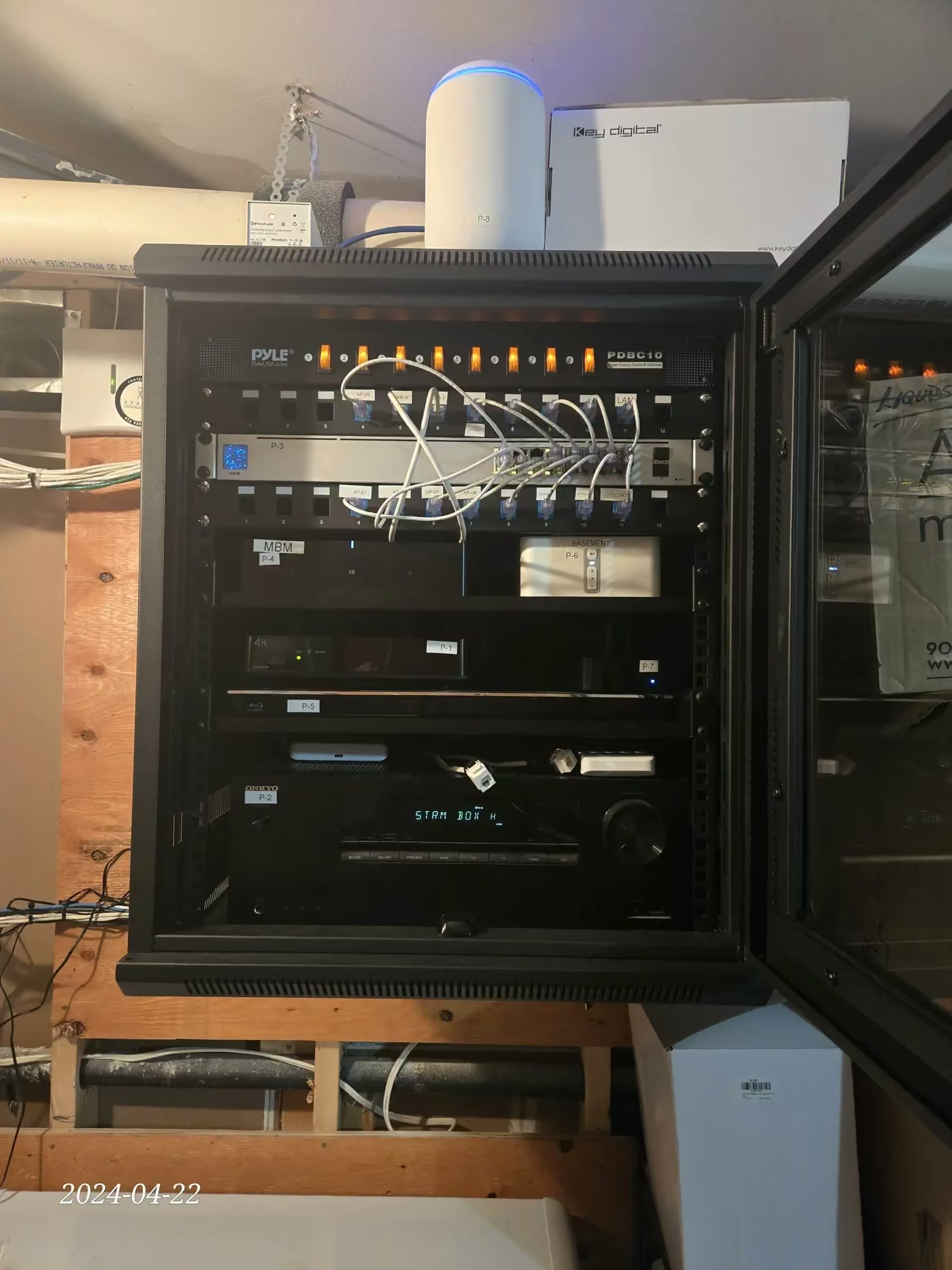
A three-storey detached house in the Observatory area had fibre at the front door and almost nothing above the main floor. The second-storey office dropped calls mid-sentence and the finished basement gave up on the signal altogether. Two generations of mesh hardware had already come and gone.
We found a clear riser through the stacked closets and pulled Cat6A up it, then ran horizontal legs to a ceiling access point on each of the three storeys, a wired drop at the office desk, TV positions on the main and lower levels, and speaker cable to the basement media room. The rack went into the utility room with a labelled patch panel, a managed PoE switch, and a written port map. The fibre hand-off lands in that rack.
The office now holds a call while the rest of the house streams. The basement media room plays without buffering. No cable shows anywhere, and the only repair work was four small access holes that the painter closed in an afternoon.
Is your cable stuck on one floor?
Tell us the storey count, where the internet service enters, and which rooms need a connection. We respond with a route plan and a clear estimate.
Oak Ridges · Jefferson · Mill Pond · Observatory · Langstaff · Bayview Hill · Rouge Woods · Devonsleigh Contact UsRetrofit Wiring Questions
Multi-Storey Homes
Network Installation Near You in the GTA
SetupTeam serves communities across the Greater Toronto Area.
Book a Richmond Hill Network Installation
A riser pull, a storey that never got wired, or a home office that keeps dropping. Pick a time and we confirm the scope before the visit.

