

Secure Your UniFi Home Network with a Professional Remote Setup
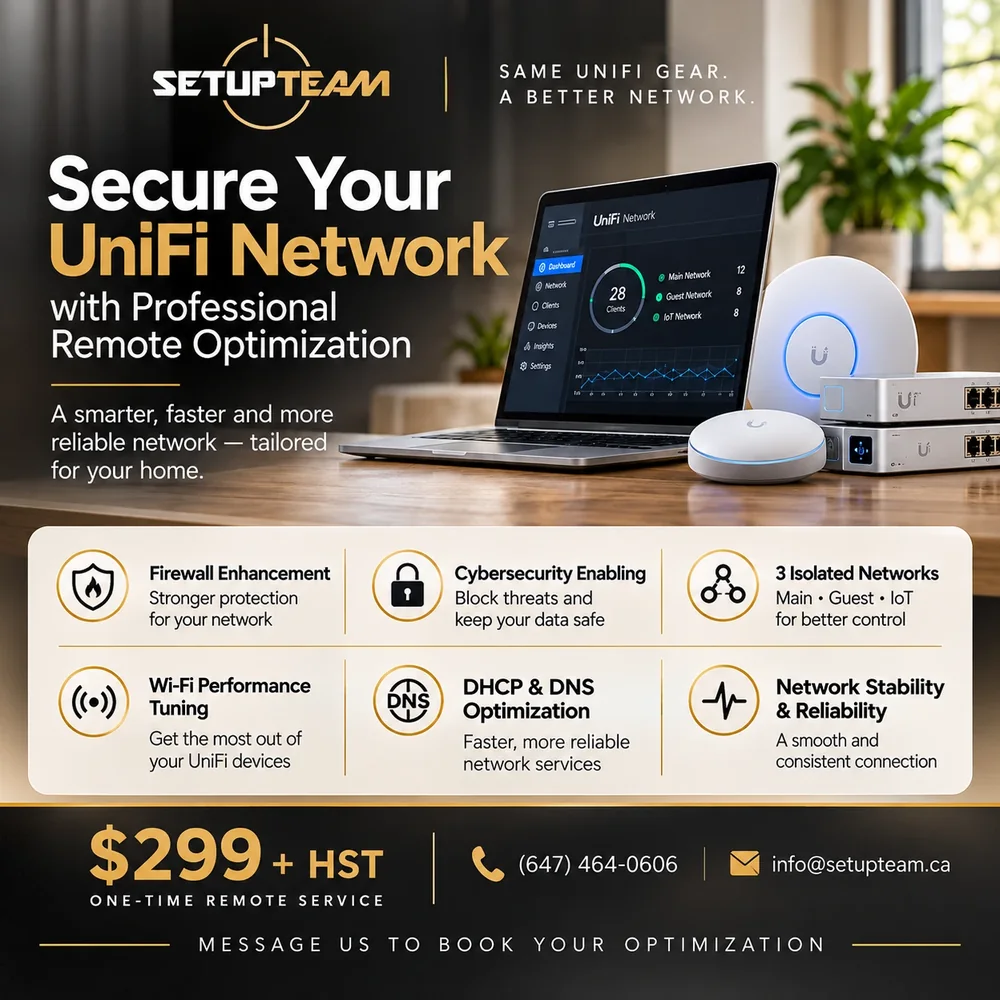
Same UniFi gear. A better network. We log in to the UniFi system you own and switch on its built-in protection. Your smart devices and guests get networks of their own, and we bring the software up to date. No visit, no new equipment: $299 + HST, or less if you bought your UniFi from SetupTeam.
What does remote UniFi security setup include?
We connect to your UniFi system over the internet and change its settings so it protects your home better. We turn on the security tools already built into your UniFi equipment, split your home into three networks, tune the Wi-Fi and update the software. You pay one fixed price, and nobody comes to your house.
Firewall Enhancement
A firewall is the rulebook that decides what can travel into your home and between your devices. We replace old or messy rules with a design that blocks everything by default and allows only what your home needs.
Cybersecurity Enabling
UniFi has security tools built in, and we switch them on. That includes intrusion prevention, which watches traffic for known attack patterns and blocks them, and a decoy alarm that raises an alert when something goes snooping. No subscription needed.
3 Isolated Networks
Your main network stays as it is, so phones and laptops keep working. IoT, meaning smart TVs, streaming boxes, plugs and doorbells, gets a network of its own. Guests get the internet and can cast to your TV, and the rest stays closed to them.
Wi-Fi Performance Tuning
We adjust the Wi-Fi units on your ceilings and walls: how much airspace each one uses, how they pass your phone along as you walk between rooms, and which band each device joins. Older gadgets get settings they accept.
DHCP & DNS Optimization
DHCP gives each device its place on your network, and DNS is the internet’s address book. We set both up so guests use a separate, filtered address book and your own devices use a safer one.
Network Stability & Reliability
We bring the UniFi software, and the firmware inside every UniFi device, up to date. Updates fix known problems, security holes included, and help keep your connection smooth and consistent.
We also switch your home to a security-focused internet address book. Before a phone, laptop or TV opens a website, the service checks the address against an updated list of known scam and malware sites, and the dangerous ones don’t load. It covers every device that uses your network’s address book, which is most of them, including smart TVs that can’t run antivirus. Your family’s lookups leave your home encrypted, so nobody along the way can read or change them, and browsing doesn’t slow down.
Why does AI make an out-of-date home network riskier in 2026?
AI helps attackers find weak spots faster and write more convincing scams. The Canadian Centre for Cyber Security said in June 2026 that new AI models shorten the time defenders have to respond, in some cases from days or weeks to hours. For a home, an out-of-date, wide-open network gives attackers more to work with, sooner.
The Cyber Centre’s statement also warns that AI lets attackers produce more convincing scam messages and fake voices, faster and at greater scale. Anthropic, the AI company, reported in November 2025 that one attacker used AI to do 80 to 90 percent of a spying campaign against organizations. Google’s threat intelligence team found malware that uses AI while it runs.
The UK’s National Cyber Security Centre says the gap between a flaw going public and attackers using it has shrunk to days. None of these reports measured attacks on individual homes. An April 2026 advisory signed by the Cyber Centre, the FBI and others does describe hacking networks, run by China-linked groups, built mainly from hijacked home and small-office routers and smart devices, many of the routers too old to get security updates.
Fraud losses reported to the Canadian Anti-Fraud Centre, 2021 to 2025
The losses Canadians reported rose every year, from $383 million in 2021 to a record of over $704 million in 2025.
- $383M2021
- $530M2022
- $567M2023
- $638M+2024
- $704M+2025
The Canadian Anti-Fraud Centre estimates that victims report only 5 to 10 percent of fraud, so real losses are higher. The figures cover all fraud, not only attacks on home networks. Sources: Canadian Centre for Cyber Security (2021 to 2023), Canadian Anti-Fraud Centre (2024 and 2025).
View the data as a table
| Year | Fraud losses reported to the CAFC (CAD) |
|---|---|
| 2021 | $383 million |
| 2022 | $530 million |
| 2023 | $567 million |
| 2024 | Over $638 million |
| 2025 | Over $704 million |
Your smart TV and gadgets get a network of their own
We move smart TVs, streaming boxes, plugs, bulbs, thermostats and doorbells onto their own network, called IoT. They still reach the internet, and your phone still controls them. What they can’t do is start a connection to your phones and laptops, apart from a small timing signal AirPlay needs, so a hacked gadget can’t reach the computer you bank on.
Smart gadgets are a common weak spot. The FBI warned in June 2025 that criminals had infected millions of streaming boxes, projectors and picture frames, some with harmful software on them before sale. Gadgets on Wi-Fi move by joining the new smart-device Wi-Fi. Most need reconnecting in their own app, and we tell you which ones and how.
Which smart devices carry the most detected weak spots
Share of detected smart-device vulnerabilities (weak spots) by device type in 2025. Bitdefender and NETGEAR, vendor data.
- Streaming devices25.9%
- Smart TVs21.3%
- Internet cameras8.6%
- Every other kind of device44.2%
Source: Bitdefender and NETGEAR, 2025 IoT Security Landscape Report (vendor data from more than 6.1 million smart homes). The last row is the remainder to 100%.
View the data as a table
| Device type | Share of detected smart-device weak spots |
|---|---|
| Streaming devices | 25.9% |
| Smart TVs | 21.3% |
| Internet cameras | 8.6% |
| Every other kind of device | 44.2% |
Before: one network for everything
After: three separate networks
| From ↓ To → | Main | Smart devices | Guest | Internet |
|---|---|---|---|---|
| Main | Same network | Allowedyour phone controls the TV and gadgets | Blockedexcept replies when a guest casts | Allowed |
| Smart devices | Blockedcan answer your phone; only AirPlay’s timing signal starts here | Same network | Blocked | Allowed |
| Guest | Casting onlythe openings AirPlay and Sonos need | Casting onlythe openings casting to your TV needs | Blockedguests can’t see each other | Allowed |
Five layers sit between the internet and your devices
Your UniFi gateway sits between the internet and everything in your home, so that’s where the protection goes. Each layer catches a different kind of problem, so a threat that slips past one still has to get past the others. No single layer stops everything, which is why we set up all five.
Safer internet address book
Before a device opens a website, the service checks the address against an updated list of known scam and malware sites. The dangerous ones don’t load on any device that uses it.
Intrusion prevention
The gateway watches traffic for known attack patterns and blocks what matches. We set it to warn and block on every network in your home.
Block-by-default firewall
Each new network starts with everything blocked. We then allow the few exceptions your home needs, such as casting to the TV and checking the time.
Separate networks
Main, smart devices and guests live apart. A gadget can’t start a connection to your laptop, and a guest’s phone gets only what casting needs, which limits how far a problem can spread.
Updates and a decoy alarm
Current software closes known holes. A decoy address sits on your main and smart-device networks like a tripwire, and anything that pokes at it raises an alert.
Lock down the UniFi network you already own for $299 + HST, with no visit and no new hardware.
Book Your OptimizationWill AirPlay, Chromecast and Sonos still work?
Yes. We set your UniFi gateway to pass casting requests between your main network and your smart devices, so your phone still finds the TV and speakers when you send a video or song. Sonos stays on your main network, because Sonos supports one network. Guests can still cast to your TV and Sonos.
- Your main network stays as it is, so phones and laptops keep working.
- Your phone still finds the TV, streaming box and smart gadgets to control them.
- AirPlay and Chromecast keep working between your main network and your smart devices.
- Sonos stays on your main network, since Sonos supports only one network.
- Guests can cast to your TV and Sonos, and the rest of your network stays closed to them.
- A Wi-Fi TV that streams 4K may stay on your main Wi-Fi for speed; we tell you which.
How does the remote session work?
You invite us as an administrator on your UniFi system, or share your screen while we work. We use the least access that does the job, save a copy of your current settings, make the changes and test the result. Afterwards you can remove our access. Nobody needs to visit your home.
Tell us what you have
Message or call us to book. Tell us which UniFi gateway you have, if you know it, and anything about your network that already bothers you.
Invite us as an administrator
We send simple instructions for adding us as an administrator in UniFi Site Manager, UniFi’s online account page. If you’d rather not, we can do the work while you share your screen.
We back up your settings
We read how your network is set up now and show you the plan. Before we change anything, we save a copy of every setting we change or remove, so it can go back the way it was.
We make the changes
We set up the three networks, the firewall rules and the security tools, tune the Wi-Fi and the address settings, and update the UniFi software and device firmware.
We test before we finish
We check that your devices are still connected, that your phone still reaches the TV and smart gadgets, and that guests are kept apart from your devices and from each other.
We walk you through it
We walk you through what changed. Then you can remove our administrator access. If you’re on a support plan, you can keep it in place, if you like, so we can help later.
This needs a working internet connection and a UniFi gateway that is switched on and working. If either one is down, there is nothing for us to log in to, and the fix becomes an on-site visit through UniFi troubleshooting. Older and entry-level gateways may not support every protection on this page, so we check yours when you book.
What does it cost, and is it part of a support plan?
The price depends on where your UniFi came from. If you bought it elsewhere, the setup costs $299 + HST, one time. If you bought your UniFi from SetupTeam and are no longer on a support plan, it costs $149.99 + HST. On a SetupTeam 1-year support plan, it is included.
For homes running UniFi bought from a store or another installer. One fixed price for the remote security setup, with no visit and no new hardware.
- Firewall, intrusion prevention and decoy alarm on
- Separate networks for smart devices and guests
- Wi-Fi tuning and software updates
- Your settings backed up before any change
For homes that bought their UniFi from SetupTeam and are no longer on a support plan. The same remote setup at a lower price.
- Firewall, intrusion prevention and decoy alarm on
- Separate networks for smart devices and guests
- Wi-Fi tuning and software updates
- Your settings backed up before any change
The remote security setup is part of the SetupTeam 1-year support plan. If your home runs UniFi and your plan is active, ask us to book it.
- Firewall, intrusion prevention and decoy alarm on
- Separate networks for smart devices and guests
- Wi-Fi tuning and software updates
- Our access can stay for later help
Who is this for, and who should book something else?
It is for homeowners who already run UniFi and whose network works, but whoever set it up left every device on one shared network or left the settings loose. If you don’t have UniFi yet, or something is broken or offline, a different service fits better, and the list below points you to it.
A good fit if
- You have a UniFi Cloud Gateway, Dream Machine or Dream Router
- Your network works, but every device shares one network
- Smart TVs and plugs sit on the same network as your laptops
- Guests join the same Wi-Fi as your family
- You want it secured without anyone visiting your home
Book something else if
- No UniFi, only your internet provider’s router: see UniFi installation
- Something is broken, dropping or slow: see UniFi troubleshooting
- Your internet or UniFi gateway is down: book an on-site visit through UniFi troubleshooting
- You need new UniFi equipment or cable runs: see UniFi installation
What can this setup not do?
This setup closes the known gaps in your UniFi network and limits how far a problem can spread. It can’t do everything. Scam calls and fake login pages reach you through people rather than through the network, and those still need your judgement.
Nobody can promise zero break-ins
No installer can promise a network that nobody will ever break into. What we can do is close the known gaps, switch on the protection your equipment already has and tell you where the limits sit.
Brand-new attacks can slip past
Intrusion prevention recognises attacks by their known patterns. A brand-new attack that nobody has catalogued yet can pass unnoticed, which is why updates and separate networks stay in place as backup.
It can’t stop scam calls
A firewall can’t stop a phone scam, an AI copy of a relative’s voice or a password you type into a fake website. The FBI suggested in December 2024 that families agree on a secret word to check callers.
It can’t clean an infected device
Separate networks limit how far an infected gadget can reach, but they don’t remove the infection. The FBI warned in June 2025 that some streaming boxes come with harmful software already on them.
Our home cybersecurity guide carries the source links for the fraud and smart-device figures on this page, with a longer explanation of firewalls and smart-device networks.
Questions about remote UniFi security.
UniFi Network Security Near You in the GTA
SetupTeam serves communities across the Greater Toronto Area.
Ready to lock down your UniFi network?
Message us with the UniFi gear you have and we’ll book a time for the remote session. You can also call (647) 464-0606 or email [email protected], daily from 8:30 AM to 9 PM.

